
Aaron Siskind

Aaron Siskind
To artist biography

Aaron Siskind

Which art books, prints and posters are available by and about this artist? Here is a sample of items of interest to a typical collector:
Book images

Horizon press

1959
with:
Edition:
1st
Edition size:
Out of Print
Other edition(s):
Hardcover with dust jacket
ISBN:
Condition: Very Good in Good+ DJ

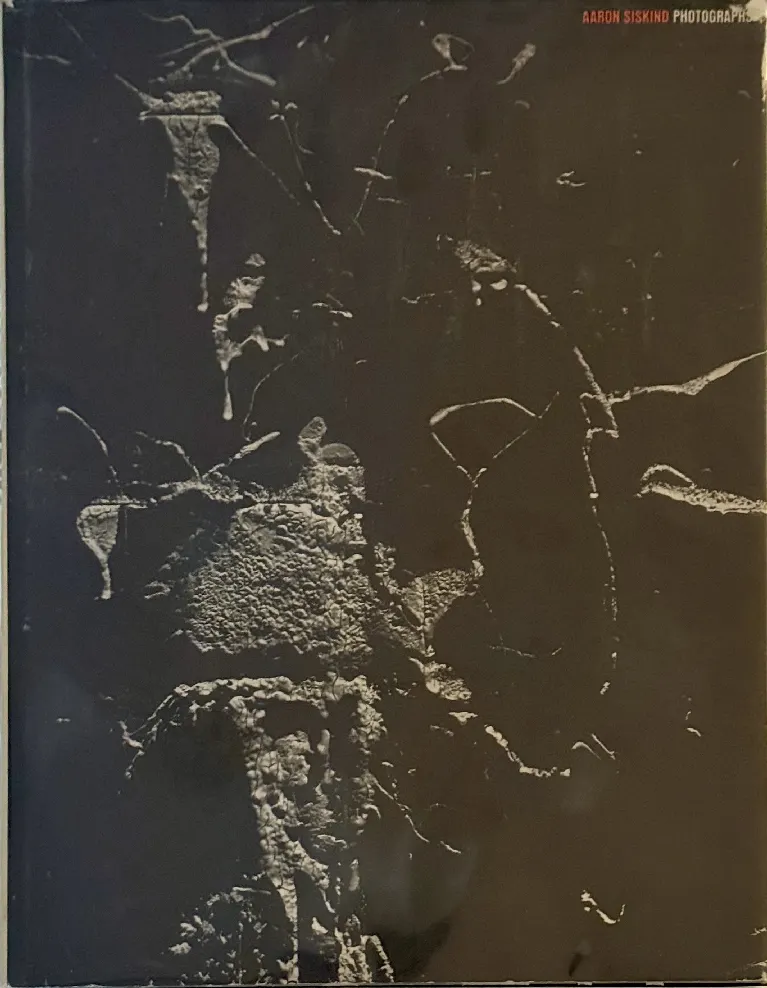
The 1959 self-titled monograph, Aaron Siskind: Photographs, published by Horizon Press, is a holy grail for a formalist collection. This was Siskind’s very first monograph, and its publication marked a watershed moment in the history of the medium; it was the book that effectively forced the photographic world to accept absolute abstraction as a legitimate, autonomous fine art form.

In 1959, the photography book was almost exclusively used for documentary storytelling or sequencing narratives. Siskind and Horizon Press who brought in Chermayeff to design the book shattered this convention.

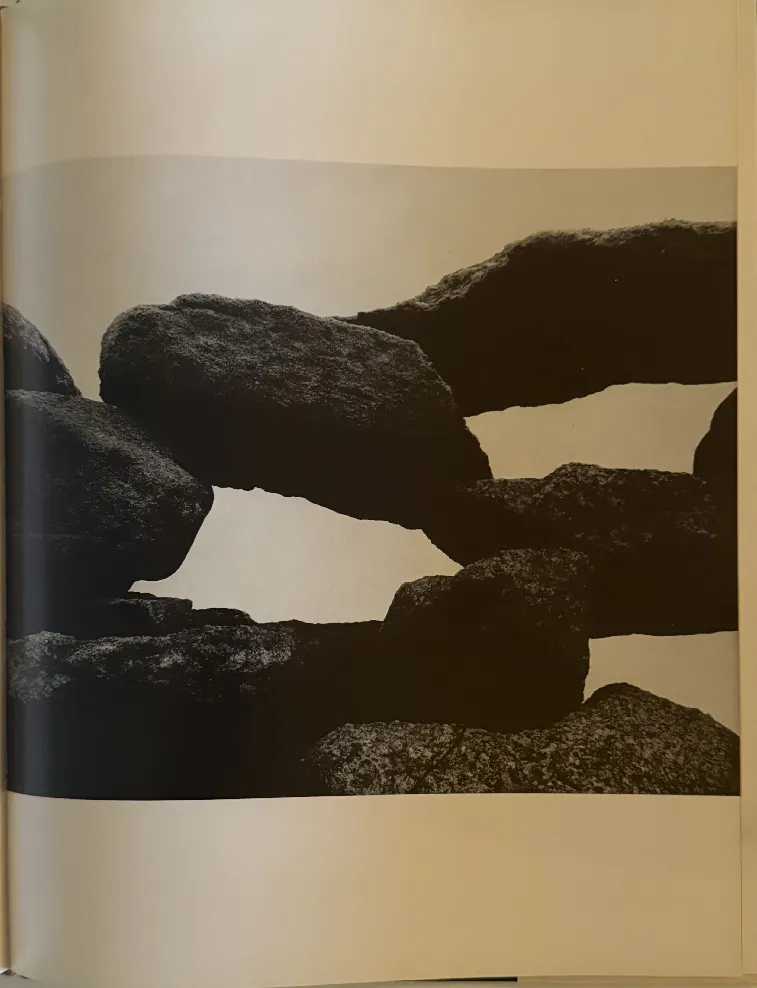
Chermayeff, who went` on to become one of the most legendary figures in American graphic design (co-founding the prominent firm Chermayeff & Geismar), brought a clean, modernist structural sensibility to the project. His design choices were instrumental in framing the book as an autonomous art object. By stripping away all text from the image pages and utilizing a bold, minimalist typographic layout for the cover and title pages, Chermayeff ensured that the viewer's focus remained entirely on the formal, two-dimensional qualities of Siskind's abstractions. The book features 50 stark, full-page plates with zero textual distraction on the image pages. It isolates his cropped frames of chipped paint, corroded metal, and weathered wood, translating three-dimensional urban detritus into purely two-dimensional graphic structures.

The production value of this first edition is incredible. It was printed using a high-quality sheet-fed gravure process that achieved deep, velvety, ink-rich blacks and a remarkably tactile surface texture. For a formalist collector, this printing method is vital: the ink sits on the heavy paper in a way that perfectly replicates the raw, gritty physical surfaces Siskind photographed, bridging the gap between the original mechanical object and the reproduced page.

Lastly, the book features a stellar introduction by the influential art critic Harold Rosenberg, a champion of Action Painting. Rosenberg's text explicitly ties Siskind’s photographic frame to the canvas of the Abstract Expressionists (like Franz Kline and Willem de Kooning), cementing the idea that the camera could be used not to record an exterior scene, but to construct a self-contained visual order.

1976
with:
Edition:
1st
Edition size:
Out of Print
Other edition(s):
Hardcover with DJ
ISBN:
Condtion: Very good in Good DJ
1976
Out of Print
Signed
Edition:
1st
Prior edition(s):
Hardcover with DJ
Condtion: Very good in Good DJ
Edition:
Uneditioned
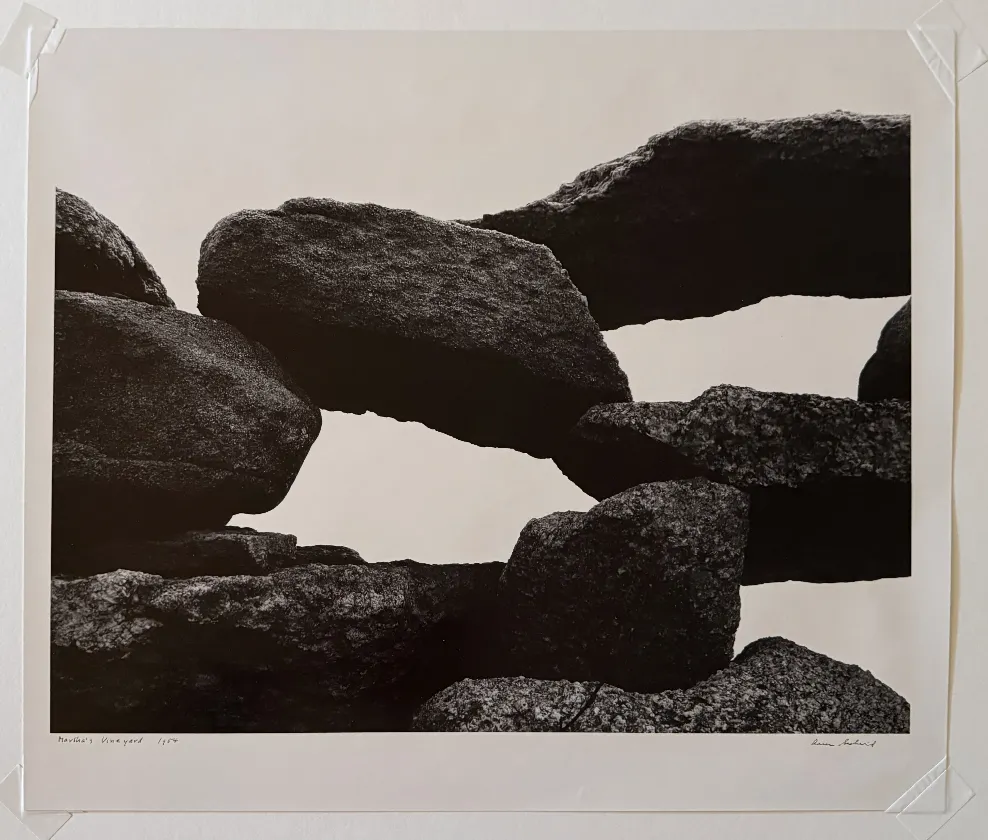
Signed and titled on the print's recto.
Year of work:
1954
Image size:
41 x 55.8 cm
Print size:
50.8 x 61 cm
Printed in
Framed size:
unframed
Provenance:
The Halstead Gallery, Birmingham, MI
C-Print
Condition:
Fine

Aaron Siskind began his career in the 1930s as a documentary photographer with New York's Photo League, producing socially conscious photo essays like The Harlem Document. However, during visits to Martha’s Vineyard in the 1940s, his approach underwent a radical shift. He began photographing close-up, worn, and overlooked surfaces, such as weathered wood, rope, peeling paint, and beach debris, ripping them of their real-world context to focus strictly on graphic form, texture, and lines.

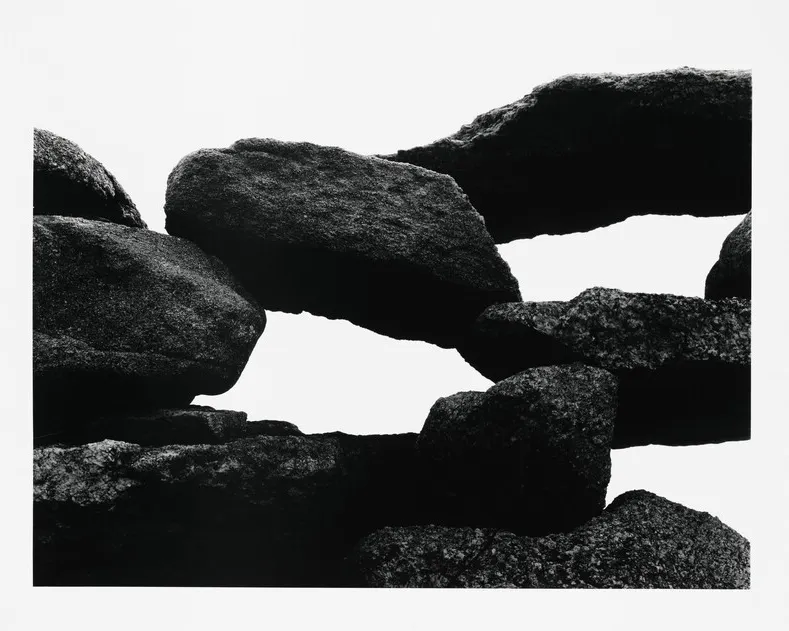
By 1954, when Martha's Vineyard, IIIB was created, Siskind was closely aligned with the Abstract Expressionist painters of the New York School, including Franz Kline, Willem de Kooning, and Mark Rothko. Like the painters of his circle, Siskind treated the two-dimensional picture plane as the primary space of creation rather than a window into three-dimensional reality. His Martha's Vineyard series transforms organic and architectural details into stark, calligraphic shapes that resemble bold brushstrokes or gestural mark-making.

Literature and Collections:

Aaron Siskind, Photographs, 1959, plate 36; Aaron Siskind: Pleasures and Terrors, Little Brown & Company, 1982.

Other impressions of this photograph are included in the permanent collections of the Whitney Museum, NY (Accession # 99.66.2) and the National Gallery of Art, DC (Accession # 2022.154.52).

edition:
Uneditioned
Sold Out
Signed and titled on the print's recto.
Image size:
41 x 55.8 cm
Year of work:
1954
Edition:
Uneditioned
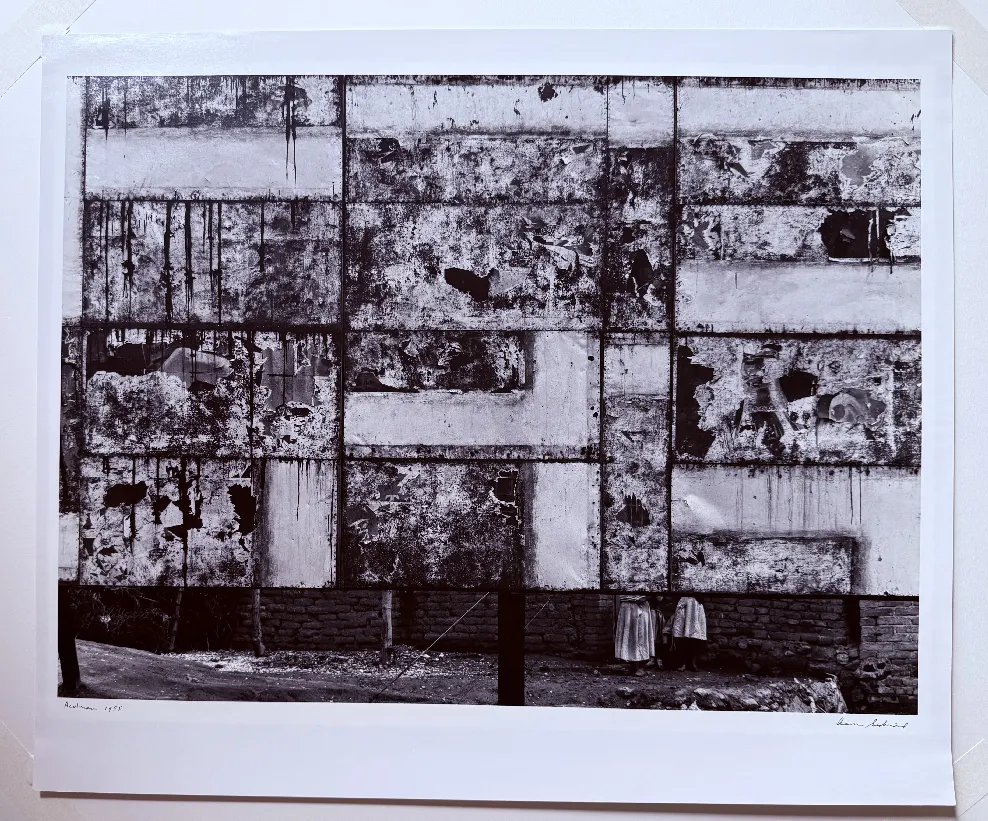
Signed on the print's recto below the image.
Year of work:
1955
Image size:
41.6 x 56.7 cm
Print size:
50.9 x 60.7 cm
Printed in
Framed size:
unframed
Provenance:
The Halstead Gallery, Birmingham, Michigan
Gelatin silver print
Condition:
Condition: near fine with a handling mark to the bottom right of the print

This striking image, Celaya (1955), is a pivotal work by Siskind that illustrates a transition point in his artistic trajectory. Taken during his travels through Mexico in 1955, the photograph serves as a bridge between his early roots in social documentary and his celebrated mid-century abstract formalism.

Siskind began his career in the 1930s as a documentary photographer with the New York Photo League, capturing socially conscious, narrative-driven series like the Harlem Document. However, by the early 1940s, he grew dissatisfied with the limitations of purely representative documentary work.

He shifted his focus toward exploring internal formal relationships, becoming the only photographer closely aligned with the Abstract Expressionist painters of the New York School (including his close friends Franz Kline, Willem de Kooning, and Mark Rothko). Siskind famously wrote:

"First, and emphatically, I accept the flat plane of the picture surface as the primary frame of reference of the picture."

Rather than using perspective to create an illusion of depth, Siskind treated the photographic frame as a flat, two-dimensional canvas. He used extreme close-ups, tight cropping, and sharp focus to transform everyday, weathered surfaces, like peeling paint, cracked asphalt, and crumbling masonry, into purely graphic arrangements of line, texture, and tone.

In Celaya, we see Siskind engaging with these formalist principles on a grander, architectural scale:

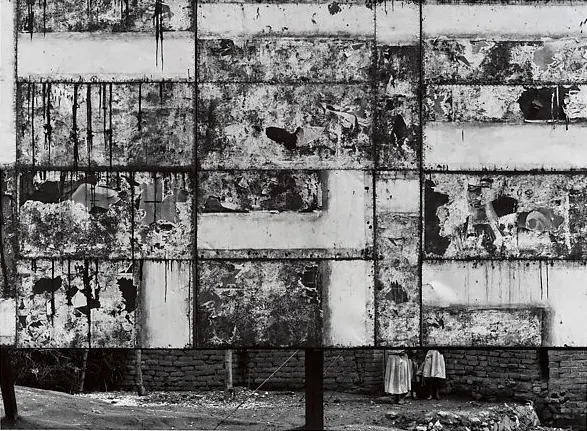
  • The Geometric Grid: The composition is dominated by the monumental, flat plane of a decaying facade. The intersecting vertical and horizontal lines of the architecture divide the frame into a rigorous, modernist grid, reminiscent of a geometric abstract painting.
  • Texture and Decoy: The surface of the wall is heavily textured with peeling plaster, exposed brick, dark streaks of water damage, and weathered patches. Siskind utilizes the high-contrast qualities of the gelatin silver print to emphasize these tactile, graphic details.
  • The Human Element: Unlike many of Siskind’s purely abstract works from this period, which completely isolate details to erase their real-world context, Celaya retains a sense of scale. At the bottom right of the frame, two small figures stand behind a low barrier.
  • Scale and Tension: The inclusion of these figures creates a powerful compositional tension. The colossal, abstract wall looms over them, turning the physical environment into a massive, overwhelming field of texture and shape. It forces the viewer to oscillate between reading the image as a literal, three-dimensional space with human subjects, and a flat, two-dimensional abstract composition.

Literature and Collections:

Other impressions of this photograph are included in the permanent collections of the Metropolitan Museum Of Art, NY (Object Number 1985.1149.10); the Art Institute of Chicago (Reference # 1964.301) and the High Museum, Atlanta (Accession # 74.224).

edition:
Uneditioned
Sold Out
Signed on the print's recto below the image.
Image size:
41.6 x 56.7 cm
Year of work:
1955
No items found.
No items found.

Born in New York City, Aaron Siskind graduated from the City College of New York in 1926 and taught high school English until he became interested in photography in 1930. In 1933 he joined the Film and Photo League in New York, a group of documentary photographers devoted to improving social conditions in contemporary society through their pictures. While involved with the League, Siskind made some of his most successful and well-known documentary photographs, including those for The Harlem Document (1937-40), but he had a falling out with the organization in 1941. At the time, his work was assuming a new, more abstract focus, as evident in Tabernacle City, a series of photographs depicting the vernacular architecture of Bucks County, Pennsylvania. When his exhibition of this series at the Photo League caused many members to protest his photography outright, he left the organization and found support among Mark Rothko, Franz Kline, and other painters, who recognized his elimination of pictorial space and his concentration on the arrangement of objects within the picture plane as qualities aligning his work with their own. Siskind's photographs have been widely exhibited and he won many awards for his photography, including a Guggenheim Fellowship, and the Distinguished Photography Award from the Friends of Photography. Siskind was a photography instructor at Chicago's Institute of Design and served as head of the department there from 1961 to 1971.

Siskind's abstract photographs from the late 1940s and early 1950s were a major force in the development of avant-garde art in America. In rejecting the third dimension, this work belied the notion that photography was tied exclusively to representation. As such, Siskind's work served as an invaluable link between the American documentary movement of the 1930s and the more introspective photography that emerged in the 1950s and 60s.