
Gregory Crewdson

Gregory Crewdson
To artist biography

Gregory Crewdson

Which art books, prints and posters are available by and about this artist? Here is a sample of items of interest to a typical collector:
Book images
2020
with:
Edition:
1st
Edition size:
Numbered 1/750
Signed on a slip bound to the rear end papers.
Out of Print
Other edition(s):
Slipcased oversized softcover, 49.5 x 27.9 cm
ISBN:
9781683952213
Condition: Near Fine

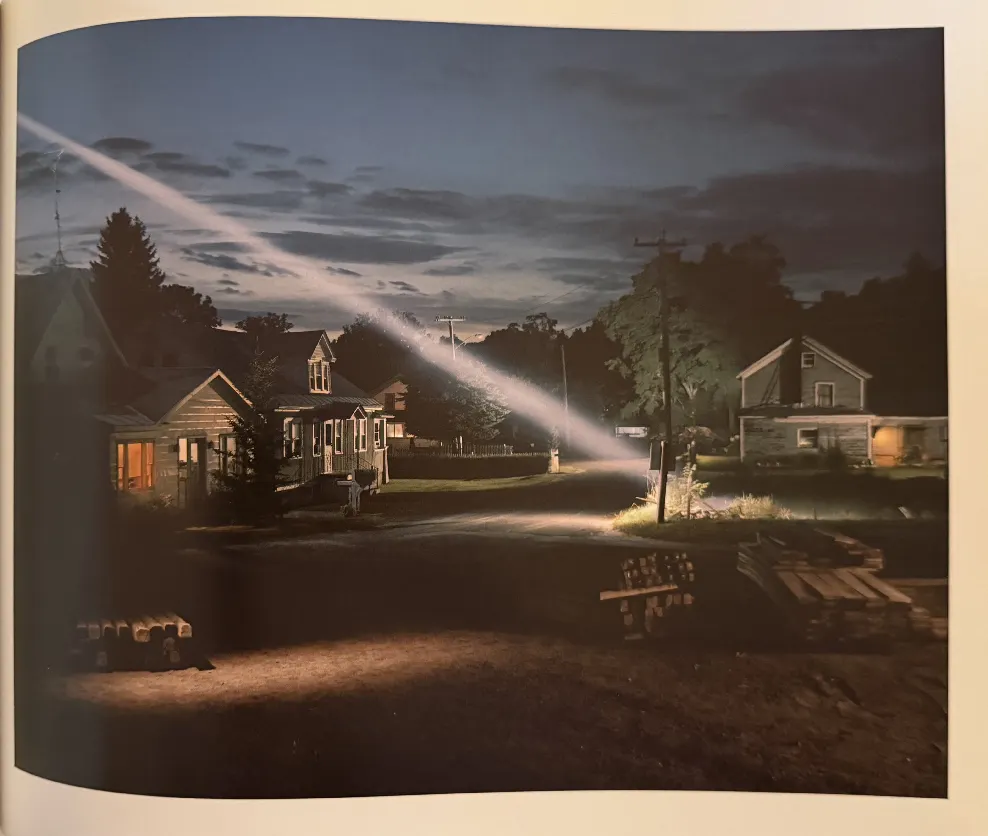
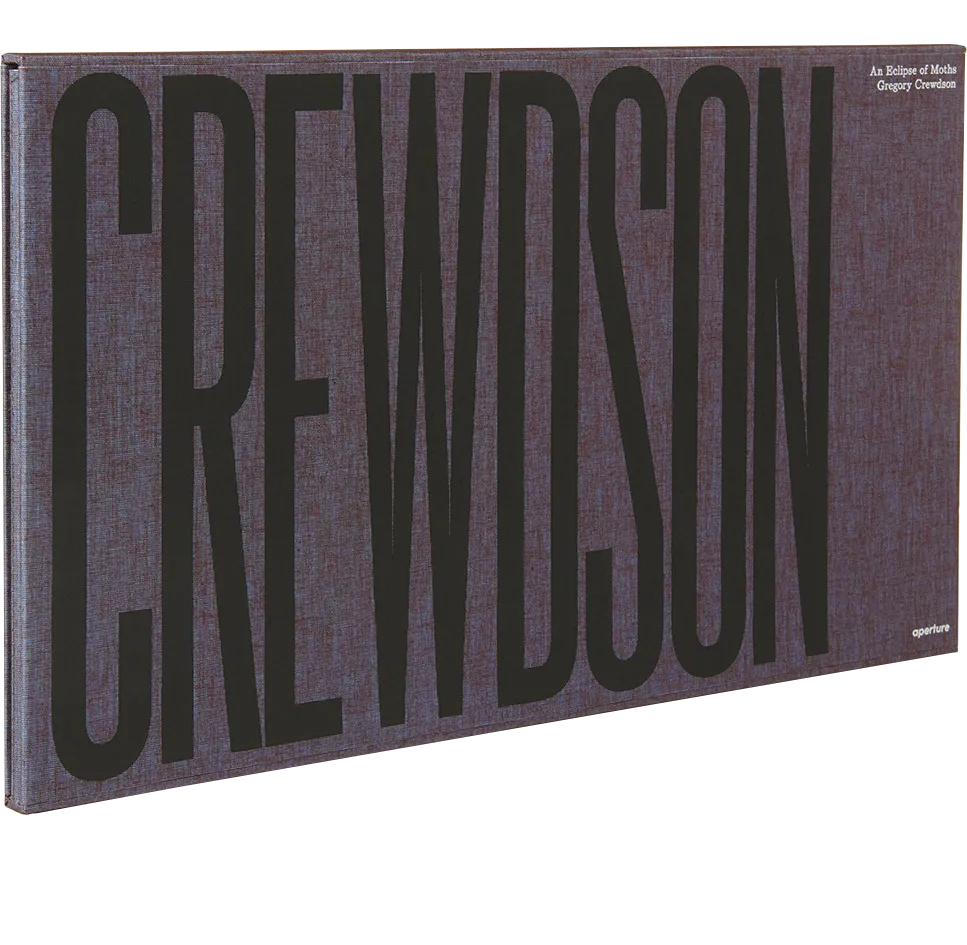
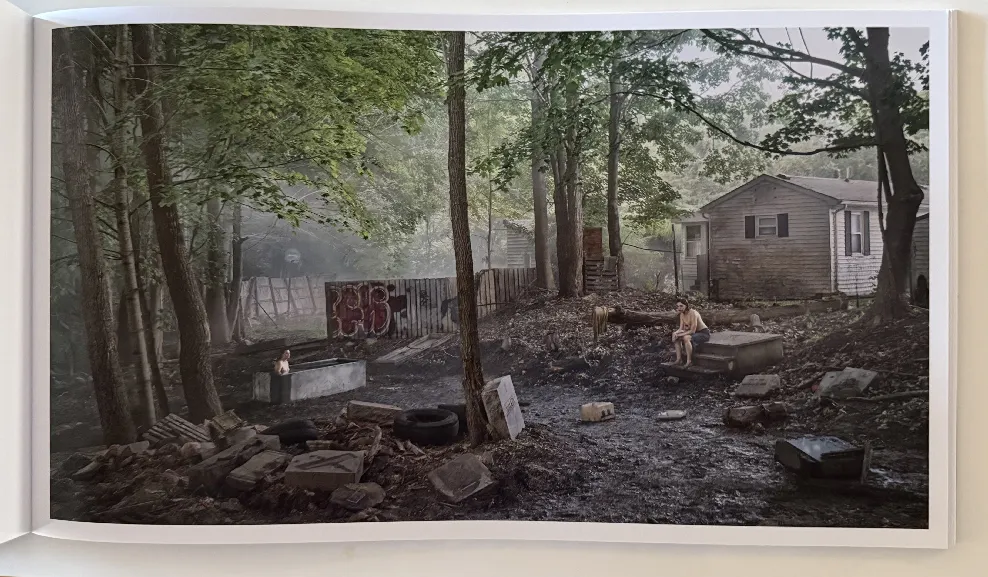
An Eclipse of Moths extends Gregory Crewdson’s obsessive exploration of the small-town, postindustrial American landscape. Each of these sixteen, never-before-published images was composed at a cinematic scale with the artist’s signature auteurial care.

Beneath the Roses is the first book published about Crewdson's large-scale photographic series of the same name. In this body of work, Crewdson expanded his production scale to rival feature films, moving beyond domestic interiors to capture entire town streets, forests, and abandoned industrial sites across unnamed small towns. Utilizing massive crews, street closures, and complex cinematic lighting rigs, the photographs depict moments of deep isolation, melancholy, and quiet disconnection. The subjects are frequently frozen in emotionally charged, ambiguous moments, capturing a visually breathtaking "calm before the storm" where epic municipal scale meets intimate human fragility.

Unlike in his previous series Dream House, Crewdson deliberately cast local actors, non-professionals, or lesser-known regional talent rather than famous faces. He relies on rigorous casting calls in the towns where he shoots (such as rural communities in upstate New York or Vermont) to find subjects whose look and anonymous, everyday quality fit the desolate, psychological mood of his fictional tableaux. The goal is to maintain an uncanny sense of realism and alienation, where the figures feel like ordinary people trapped in inexplicable, suspended moments of personal isolation.

Photology

2008
with:
Edition:
1st
Edition size:
Out of Print
Other edition(s):
Hardcover without dust jacket, as issued
ISBN:
9788888359410
Condition: Near Fine

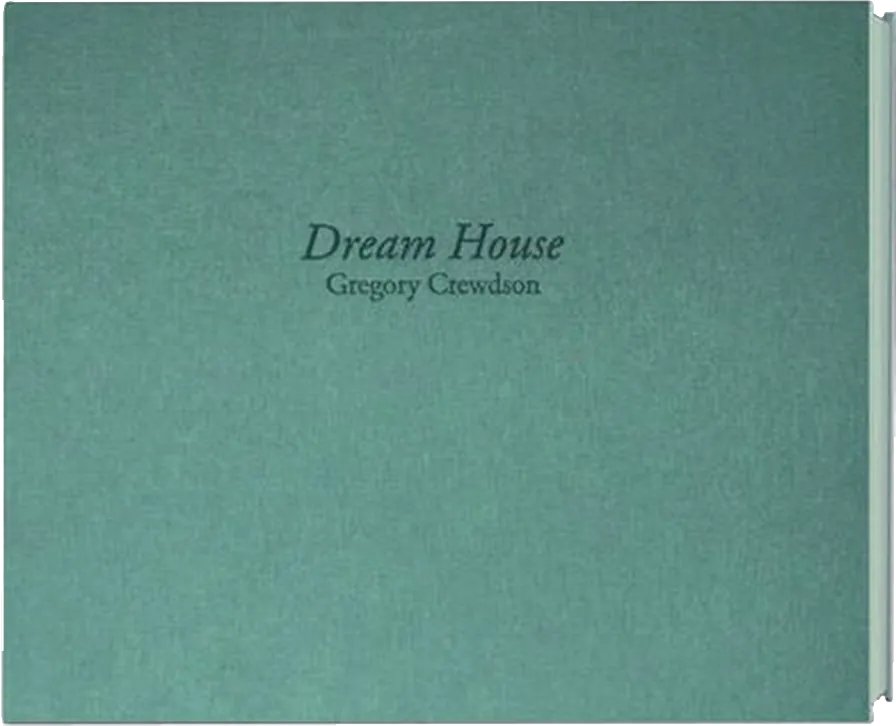
The original Dream House series was created by Gregory Crewdson between 2002 and 2004.

The project was originally commissioned by The New York Times Magazine and was published as a special widescreen photo-essay in their November 10, 2002 issue. Crewdson staged these elaborate, cinematic productions inside a vacant, dilapidated house in Rutland, Vermont, casting well-known actors, including Tilda Swinton, Gwyneth Paltrow, Julianne Moore, and William H. Macy, to portray detached, melancholic characters in eerie, suburban domestic settings.

This book was released to compile and formally document this distinct, finite body of work in a dedicated monograph format, preserving the full narrative arc of the project long after the original magazine release and subsequent gallery exhibitions.

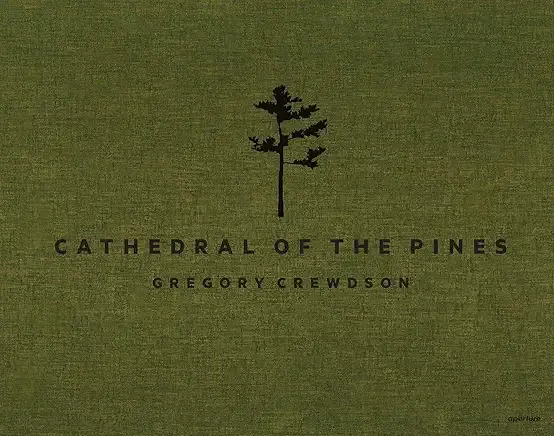
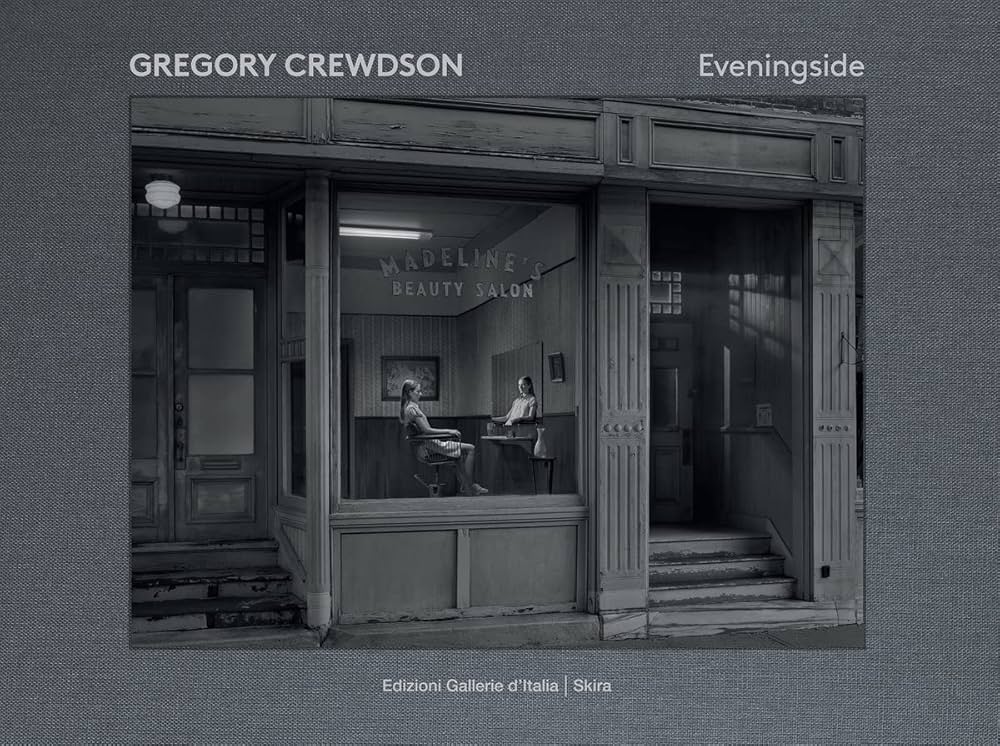
Eveningside serves as a comprehensive culmination of a decade-long photographic trilogy by Gregory Crewdson. Accompanied by text from editor and art critic Jean-Charles Vergne, the volume brings together three major bodies of work produced between 2012 and 2022: Cathedral of the Pines (2012–2014), An Eclipse of Moths (2018–2019), and the titular Eveningside (2021–2022) series.

The book traces the evolution of Crewdson’s cinematic staging over this critical period. It shifts from the intimate, color-saturated woodland scenes of Cathedral of the Pines to the sprawling, dilapidated post-industrial landscapes of An Eclipse of Moths, finally concluding with the stark, monochromatic film-noir aesthetic of Eveningside. In this concluding chapter, Crewdson explores the quiet, gothic atmosphere of everyday places of employment—such as storefronts, dairy bars, salons, and bank drive-throughs, employing complex lighting, fog, and rain to capture moments of profound contemplation in mundane routines.

Additionally, the book introduces the trilogy by looking back at his seminal 1996 series, Fireflies, providing crucial historical context for the minimalist and intimate undercurrents that continue to inform his massive, highly engineered productions. Ultimately, the monograph offers a deep dive into the nuanced political and personal landscapes that define Crewdson’s contemporary vision of a fading middle America.

Fireflies represents a striking and intimate departure from the massive, heavily staged cinematic productions for which Gregory Crewdson is primarily known. The book compiles work created during the summer of 1996, when the photographer spent two solitary months at his family's cabin in Becket, Massachusetts, obsessively documenting the evening landscape.

Using both small- and medium-format cameras, Crewdson set out each dusk to capture the glowing, erratic trails of fireflies. Stripped of his usual Hollywood-scale crews and elaborate artificial lighting rigs, this minimalist, black-and-white series reduces photography to its most elemental feature: drawing with light. The resulting 61 tritone reproductions represent a quiet, nearly impossible attempt to freeze the fleeting, elusive beauty of the insects' bioluminescence in the fading twilight.

Though visually distinct from the epic, full-color orchestrations of series like Twilight or Beneath the Roses, Fireflies is a crucial foundational work. It reveals the quiet undercurrents of isolation, longing, and the mysterious, untamed forces lurking within the rural American landscape that continue to permeate all of his later masterpieces.

Book images
2005
with:
Edition:
1st
Edition size:
Out of Print
Other edition(s):
Hardcover with dust jacket
ISBN:
9783775716222
Condition: Near Fine

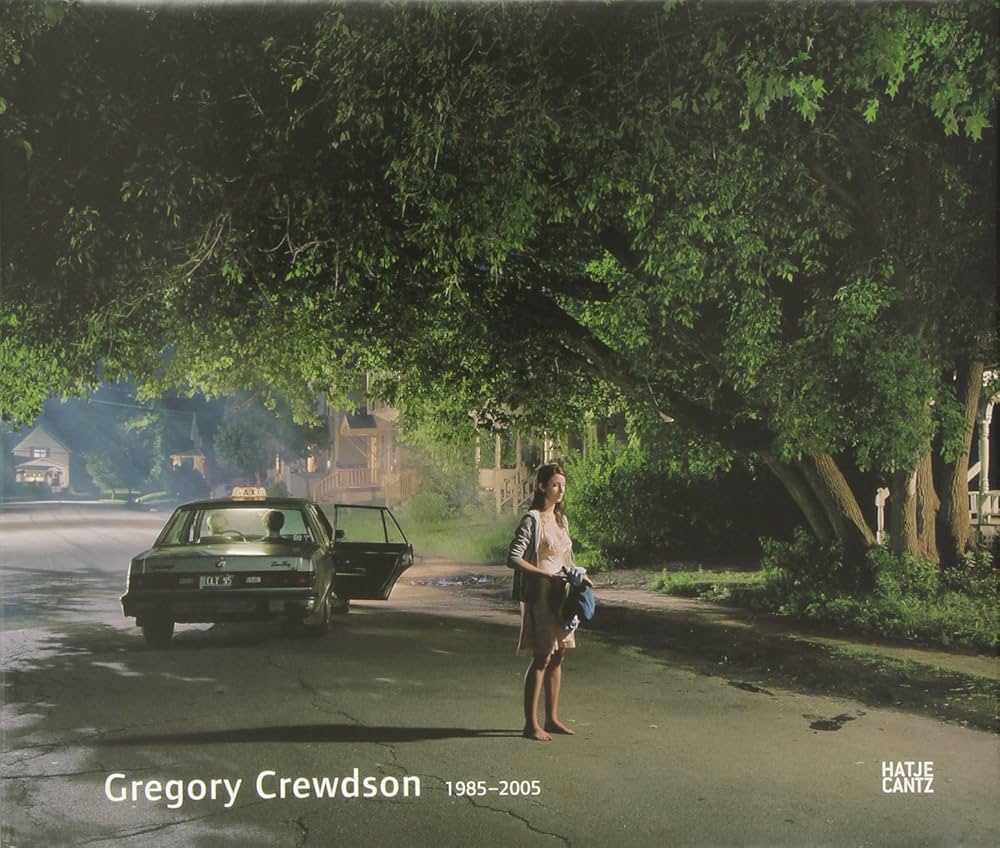
This is widely considered the definitive retrospective monograph of Crewdson's mid-career. It covers all of his major series up to that point, including Natural Wonder, Hover, Twilight, Dream House, and Beneath the Roses.

2011
with:
Edition:
1st
Edition size:
Signed
Out of Print
Other edition(s):
Cantz issued its own version that same year.
Hardcover with dust jacket
ISBN:
9781419701108
Condition: Near Fine

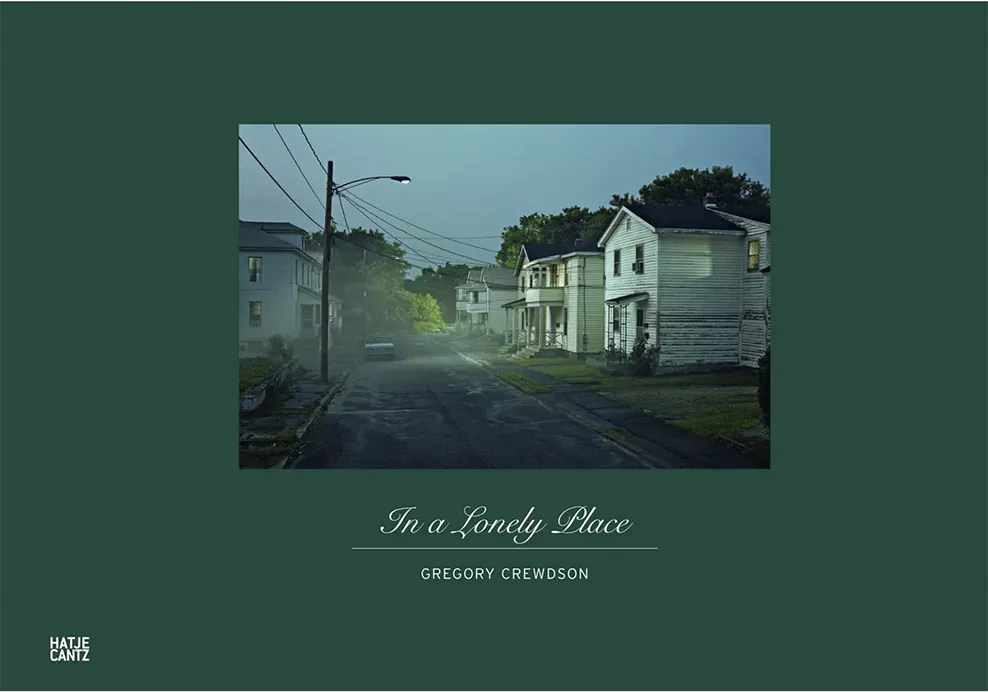
In a Lonely Place is a 2011 monograph published by Abrams that gathers Gregory Crewdson's major photographic series produced between 1985 and 2008. The book functions as a comprehensive retrospective, tracing the evolution of his cinematic, highly staged aesthetic from his early, uncanny suburban narratives, such as Twilight, to the monumental, movie-set scale of Beneath the Roses. Named in homage to the classic 1950 Nicholas Ray film noir, the publication underscores Crewdson's core exploration of American isolation, psychological suspense, and the eerie desolation hidden just beneath the surface of everyday life.

Rather than a full career retrospective, this volume acts as a comprehensive bind-up of his more recent major series, bringing together Cathedral of the Pines and An Eclipse of Moths into one cohesive book. This book is key for observing his transition into slightly more subdued, atmospheric, and politically resonant landscapes while maintaining his signature obsessive control over the frame.

Edition:
6/20
Sold Out
Signed and numbered on the back of the print.
Year of work:
Image size:
45.5 x 34 cm
Print size:
50 x 40 cm
Printed in
2015
Framed size:
unframed
Provenance:
Aperture
C Print
Condition:
Pristine

Special edition of 20 with book

Literature and Collections:
Edition:
159/460
Sold Out
Signed and numbered on print's recto on the bottom edge.
Year of work:
Image size:
283 x 227 mm
Print size:
354 x 278 mm
Printed in
2023
Framed size:
unframed
Provenance:
Avant Arte
Digital pigment print on 305gsm Moab Juniper Baryta paper
Condition:
Pristine
Literature and Collections:

Gregory Crewdson, Cantz, 2005, Plate 38.

Edition:
159/312
Sold Out
Signed and numbered on print's recto on the bottom edge.
Year of work:
Image size:
22.7 x 28.3 cm
Print size:
27.8 x 35.4 cm
Printed in
2023
Framed size:
unframed
Provenance:
Avant Arte
Digital pigment print on 305gsm Moab Juniper Baryta paper
Condition:
Pristine
Literature and Collections:

Gregory Crewdson, Cantz, 2005, Plate 51.

Another impression of this photograph is in the permanent collection of MOMA, NY (object SC2008.1.218.1).

Edition:
7/70
Sold Out
Signed and numbered on a label affixed to the print's verso.
Year of work:
Image size:
157 x 237 mm
Print size:
203 x 254 mm
Printed in
2022
Framed size:
unframed
Provenance:
Aperture
Archival pigment print
Condition:
Pristine

Released by Aperture for their 70th anniversary as the 70X70 editions. This edition of 70 was also limited in time from Sep 8 to Sep 30 2022, or when the edtion sold thrpugh. Some editions did not sell through the whole 70 prints by Sep 30, though this one did.

Literature and Collections:

Aperture Issue 190.

No items found.
No items found.

Gregory Crewdson, American, b. 1962

Born in Brooklyn, NY, Gregory Crewdson is celebrated for his cinematic, meticulously staged, and large-scale images that capture the melancholic and eerie psychogeography of small-town and post-industrial America. Earning his MFA from Yale University, where he is now the director of graduate studies in photography, Crewdson approaches image-making more like a film director than a traditional documentary photographer.

His productions famously require massive crews, elaborate set designs, street closures, and complex lighting rigs to capture a single, psychologically charged tableau. Series such as Twilight, Beneath the Roses, Cathedral of the Pines, and Eveningside evoke a silent, liminal space between the mundane and the mythic, frequently drawing comparisons to the paintings of Edward Hopper and the surreal cinema of David Lynch.

Crewdson’s practice offers a compelling intersection of highly controlled composition and an extensive, tactile output of printed material, making it highly relevant to an archive focused on formalist photography, books, and multiples like Bushwick Sur Seine. While his work is deeply narrative, the absolute precision of his lighting, staging, and framing is intrinsically formalist. Every visual element within the frame, from the angle of a shadow to the placement of a prop, is intentionally constructed and obsessively controlled. There is no reliance on chance; the image is an exercise in rigorous structural design.

From 1998 to 2002, the Twilight series solidified Crewdson’s signature directorial style, depicting intensely colored, elaborately staged tableaux that explore the psychological disquiet hidden within the American family and suburban landscape. Blurring the lines between the domestic and the fantastical, the images feature seemingly normal neighborhoods where the uncanny intrudes, from a pregnant woman covered in fireflies to flooded living rooms and strange flora growing out of residential floors. The work draws heavy inspiration from the surreal, eerie aesthetics of science fiction and independent cinema, transforming mundane domesticity into a place of wonder, isolation, and anxiety.  

Dream House (2002) occupies a fascinating, transitional space in Gregory Crewdson’s bibliography, Originally commissioned as a twelve-part portfolio by The New York Times Magazine, the series acts as a bridge between the domestic surrealism of his earlier work and the massive, cinematic scale that would define his mid-career

This move happened between 2003 and 2008 through the Beneath the Roses series. This new body of work expanded Crewdon's production scale to rival feature films, Crewdson moved beyond the home to capture entire town streets, forests, and abandoned industrial sites across unnamed small towns. Working with large crews, street closures, and complex cinematic lighting rigs, he captured moments of deep isolation and melancholy. The subjects in Beneath the Roses are often frozen in emotionally charged, ambiguous moments of disconnect or contemplation. The series cemented his ability to create a visually breathtaking "calm before the storm," where epic municipal scale meets intimate human fragility.  

Cathedral of the Pines (2013-2014) marked a period of personal and artistic transition for Crewdson, this series is named after a trail in the deep forests of Becket, Massachusetts, where he relocated. While retaining his hallmark cinematic lighting and rigorous control over the frame, the work is noticeably quieter, more intimate, and less theatrical than his earlier suburban scenes. The imagery explores a deeply personal sense of stillness and connection to the natural world, acting as a ceremonial crystallization of space, time, and hidden sorrows within rural interiors and woodland landscapes.  

Envisioned as the final movement of a trilogy spanning a decade (following Cathedral of the Pines and An Eclipse of Moths), Eveningside (2021-2022) explores moments of contemplation in and around places of everyday employment, storefront windows, bank teller drive-throughs, dairy bars, and hardware stores. For the first time using his full production team to shoot in a monochromatic palette, Crewdson employed a heightened range of light and shadow, complete with practical effects like fog, rain, and haze. The resulting black-and-white images exude a rich, gothic atmosphere evocative of classic film noir, capturing the quiet wonders and stark realities of routine, post-industrial American life.