


Which art books, prints and posters are available by and about this artist? Here is a sample of items of interest to a typical collector:

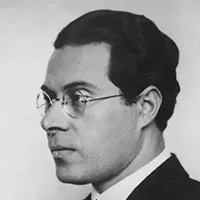
László Moholy-Nagy, Hungarian-American (1895-1946)
Moholy-Nagy was a visionary polymath whose experiments in the 1920s and 30s fundamentally redefined photography. He didn't view the camera as a tool for documenting reality, but as a medium for "New Vision"—a way to see the world through perspectives impossible for the human eye to achieve on its own.
The Philosophy of "New Vision"
Moholy-Nagy arrived at the Bauhaus in 1923, bringing a radical belief that light itself was a medium for sculpture and painting. He argued that photography should move away from "pictorialism" (mimicking traditional painting) and instead embrace its unique mechanical properties.
He championed techniques that forced the viewer to see everyday objects in unfamiliar ways:
His key photographic innovations include:
- The Photogram: Perhaps his most famous contribution was the perfection of the photogram. By placing physical objects—often translucent or metallic—directly onto light-sensitive paper and exposing them to light, he created ghostly, abstract compositions. To Moholy-Nagy, this was "writing with light" in its purest form, stripped of the "burden" of a camera lens.
- Typohoto: He coined the term "Typophoto" to describe the integration of typography and photography. He saw this as the future of communication, where the objective clarity of a photograph combined with the structural power of type would create a more potent visual language for advertising and journalism.
- Multiple Exposures and Solarization: He experimented heavily with photomontage and negative printing, often layering images to create a sense of dynamic movement and "space-time" logic. These works weren't meant to be "realistic"; they were meant to visualize the complexity of modern, industrial life.
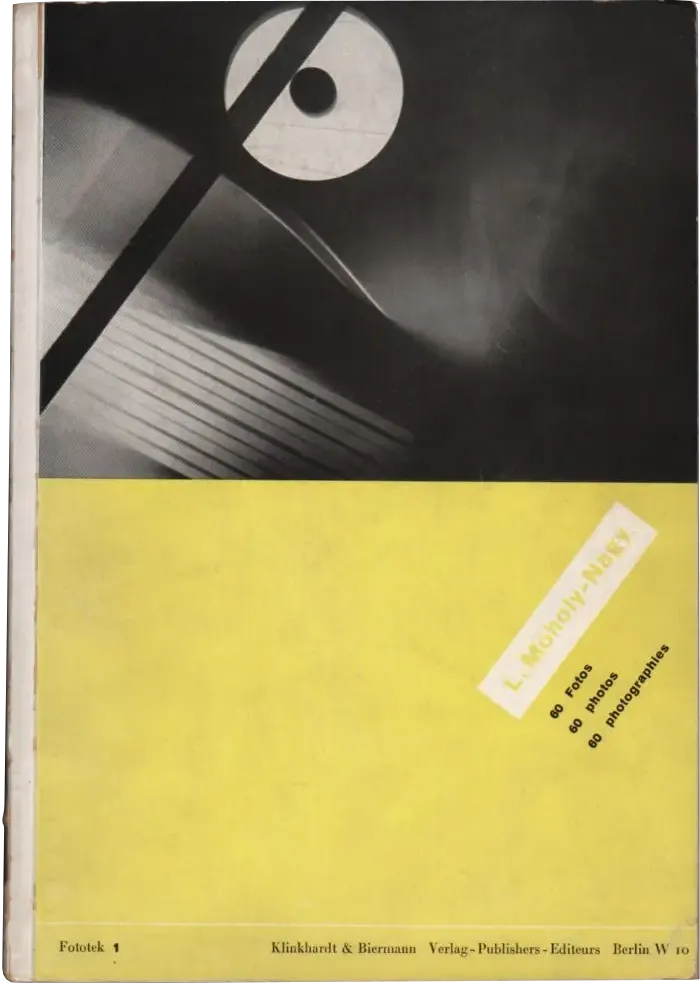
His major work and publications include: Malerei, Fotografie, Film, 1925, one of the most influential books on photography, establishing it as a primary art form; The Radio Tower, Berlin, 1928, a classic example of his extreme high-angle "Bird's-Eye" perspective, Light Space Modulator, 1930, a kinetic sculpture designed to create shifting light and shadow patterns, captured in his film Lichtspiel: Schwarz-Weiss-Grau and finally 60 Fotos, a seminal monograph published in 1930 that functions as a visual manifesto for Moholy-Nagy’s photographic theories.
After fleeing Nazi Germany, Moholy-Nagy moved to Chicago in 1937 to found the New Bauhaus (later the Institute of Design). He brought his experimental rigor to America, influencing generations of photographers to treat the darkroom as a laboratory. He passed away in Chicago at the age of 51 due to leukemia, just months after becoming a naturalized American citizen.
His work shifted photography from a hobby of "capturing moments" to a sophisticated discipline of spatial and optical research, ensuring that the camera would forever be viewed as a tool for modern intellectual inquiry.

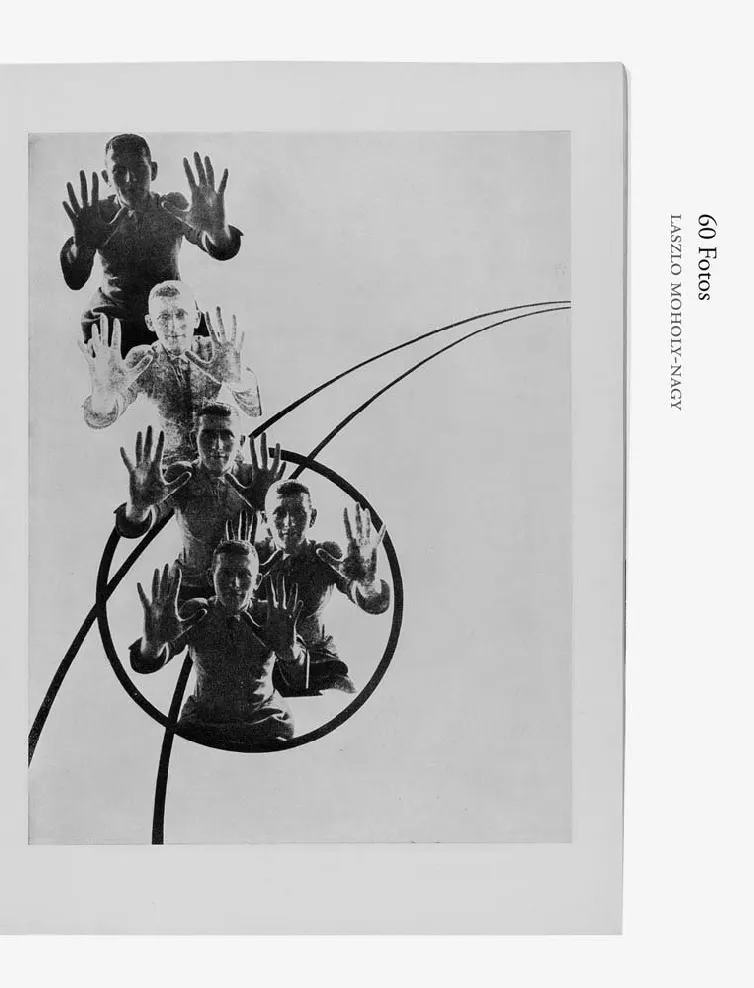
60 Fotos (or 60 Photographs) is a seminal monograph published in 1930 that functions as a visual manifesto for Moholy-Nagy's photographic theories. It was the inaugural volume in the Fototek series, edited by Franz Roh, which was intended to showcase the "New Photography" emerging from the Bauhaus and beyond.
The book is less of a traditional "portfolio" and more of a pedagogical tool. It organizes his work to demonstrate the specific technical and philosophical "problems" he was solving through the medium.
The book contains sixty full-page black-and-white plates, carefully selected to represent the full spectrum of his experimental practice:
â€
The book itself is a masterpiece of modernist design: