
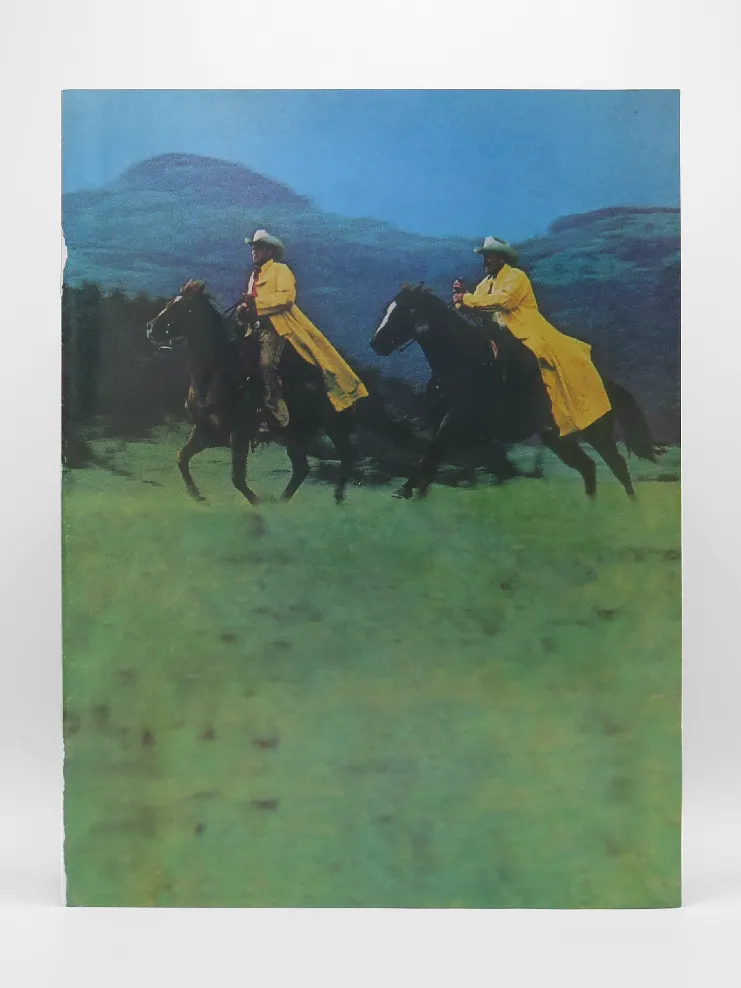
Oversized softcover, 38.7 x 29.2 cm (in its packaging cardboard box)
ISBN:


New Cowboys represents a self-reflexive evolution of Prince's most iconic and polarizing body of work. Nearly four decades after he first began rephotographing Marlboro cigarette advertisements to critique the mass-media construction of American masculinity, Prince returns to the same mythological imagery. However, rather than presenting the rugged, romanticized frontiersmen as seamless commercial illusions, this publication deliberately foregrounds the physical degradation of his source material. The project shifts the conceptual focus from the pristine myth of the cowboy to the fragile, ephemeral nature of the printed advertisement itself.
The visual aesthetics of this oversized volume rely heavily on the explicit decay of the original magazine tear-sheets. In these large-scale reproductions, the creases, scratches, torn edges, and surface abrasions of the paper are not cropped out or retouched; instead, they are magnified and celebrated as integral components of the image. This unapologetic inclusion of the physical wreckage transforms the familiar commercial cowboys into weathered, ghostly artifacts. The high-contrast, often grainy texture of the worn paper emphasizes the mediation of the image, turning a piece of disposable advertising into a tactile record of time and handling.
The book serves as a poignant reassessment of Prince's own legacy of appropriation, acknowledging the passage of time on both the subject matter and the physical medium.