
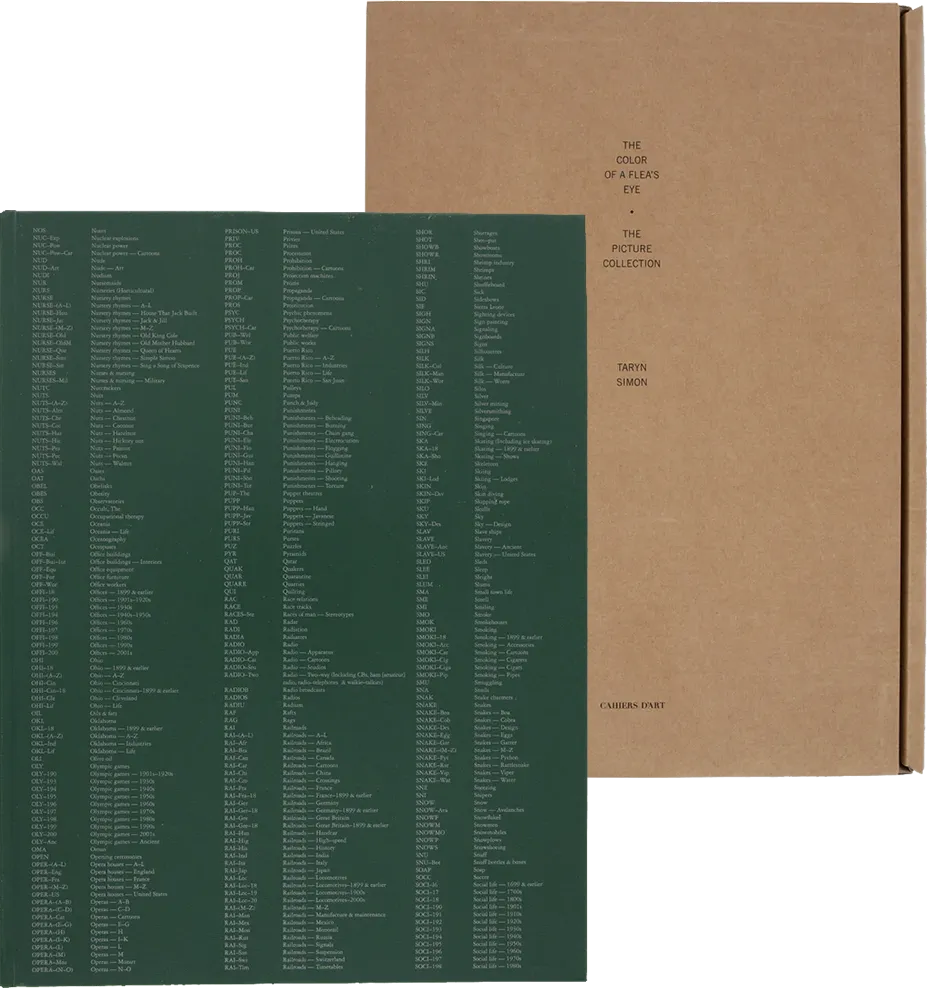


Founded in 1915, the NYPL Picture Collection contains over one million prints, photographs, postcards, clippings, and illustrations classified into thousands of subject folders. Long before digital search algorithms existed, this physical archive served as a vital, open-access visual engine for researchers, artists (such as Diego Rivera, Joseph Cornell, and Andy Warhol), designers, and the general public.
Simon explores the collection as an analog precursor to search engines, pointing to the subjective human choices, taxonomies, and invisible systems of power behind how visual information is organized, consumed, and remembered. The book’s title refers to an unusual, hyper-specific patron reference request submitted to the library in 1930.
The 460-page volume is divided into four major sections:
1. Essays: Critical text by curator Joshua Chuang and art writer Tim Griffin examining the history of the NYPL Picture Collection, its visionary superintendent Romana Javitz, and Simon’s artistic interrogation of archival structures.
2. Artworks (The Composites): Includes 57 hand-tipped plates depicting Simon’s large-format studio compositions. Simon pulled contents from specific folder categories, such as Financial Panics, Chiaroscuro, Express Highways, Police, and Handshaking,and layered them into overlapping visual tableaux that reveal accidental juxtapositions and changing social mores.
3. Archival Documents & Correspondence: A substantial section documenting letters, patron loan requests, memos, and accession records. This correspondence highlights famous artistic interactions (such as Andy Warhol borrowing and famously failing to return items) alongside the everyday demands placed on the collection.
4. The Photography Collection Transmutation: Highlights rare photographic prints by masters like Walker Evans, Dorothea Lange, Lewis Hine, and Berenice Abbott that were originally submitted to the open-circulation Picture Collection before being recognized for their fine art value and transferred into the NYPL’s permanent Photography Collection.
Designed by Joseph Logan and Taryn Simon, the book functions as an archive-in-itself, incorporating multiple paper stocks, gatefolds, tipped-in plates, and structural design elements that reflect the physical nature of paper-based archives.
As a conceptual interrogation of visual archiving, this book is central to the Bushwick Sur Seine Collection, focused on the printed matter, which is itself an archive. Rather than simply being a book of photographs, it is a project about how images are classified, stored, and retrieved. In an era dominated by digital search algorithms, Simon’s work examines the analog systems, specifically the NYPL’s physical card/folder taxonomy, that shaped how generations of artists, researchers, and the public processed visual culture. For a private archive or structured collection, it offers a meta-commentary on the nature of collecting itself.
The book also highlights "The Photography Collection Transmutation," tracing how vintage prints by pivotal modernists, including Berenice Abbott, Walker Evans, Dorothea Lange, and Lewis Hine, were originally housed in open-circulation folders as simple reference material before being recognized for their fine art value and transferred into the library's permanent fine art photography collection. It documents the historical shift in how mid-century documentary photography transitioned from utilitarian print matter into fine art.

Founded in 1915, the NYPL Picture Collection contains over one million prints, photographs, postcards, clippings, and illustrations classified into thousands of subject folders. Long before digital search algorithms existed, this physical archive served as a vital, open-access visual engine for researchers, artists (such as Diego Rivera, Joseph Cornell, and Andy Warhol), designers, and the general public.
Simon explores the collection as an analog precursor to search engines, pointing to the subjective human choices, taxonomies, and invisible systems of power behind how visual information is organized, consumed, and remembered. The book’s title refers to an unusual, hyper-specific patron reference request submitted to the library in 1930.
The 460-page volume is divided into four major sections:
1. Essays: Critical text by curator Joshua Chuang and art writer Tim Griffin examining the history of the NYPL Picture Collection, its visionary superintendent Romana Javitz, and Simon’s artistic interrogation of archival structures.
2. Artworks (The Composites): Includes 57 hand-tipped plates depicting Simon’s large-format studio compositions. Simon pulled contents from specific folder categories, such as Financial Panics, Chiaroscuro, Express Highways, Police, and Handshaking,and layered them into overlapping visual tableaux that reveal accidental juxtapositions and changing social mores.
3. Archival Documents & Correspondence: A substantial section documenting letters, patron loan requests, memos, and accession records. This correspondence highlights famous artistic interactions (such as Andy Warhol borrowing and famously failing to return items) alongside the everyday demands placed on the collection.
4. The Photography Collection Transmutation: Highlights rare photographic prints by masters like Walker Evans, Dorothea Lange, Lewis Hine, and Berenice Abbott that were originally submitted to the open-circulation Picture Collection before being recognized for their fine art value and transferred into the NYPL’s permanent Photography Collection.
Designed by Joseph Logan and Taryn Simon, the book functions as an archive-in-itself, incorporating multiple paper stocks, gatefolds, tipped-in plates, and structural design elements that reflect the physical nature of paper-based archives.
As a conceptual interrogation of visual archiving, this book is central to the Bushwick Sur Seine Collection, focused on the printed matter, which is itself an archive. Rather than simply being a book of photographs, it is a project about how images are classified, stored, and retrieved. In an era dominated by digital search algorithms, Simon’s work examines the analog systems, specifically the NYPL’s physical card/folder taxonomy, that shaped how generations of artists, researchers, and the public processed visual culture. For a private archive or structured collection, it offers a meta-commentary on the nature of collecting itself.
The book also highlights "The Photography Collection Transmutation," tracing how vintage prints by pivotal modernists, including Berenice Abbott, Walker Evans, Dorothea Lange, and Lewis Hine, were originally housed in open-circulation folders as simple reference material before being recognized for their fine art value and transferred into the library's permanent fine art photography collection. It documents the historical shift in how mid-century documentary photography transitioned from utilitarian print matter into fine art.