
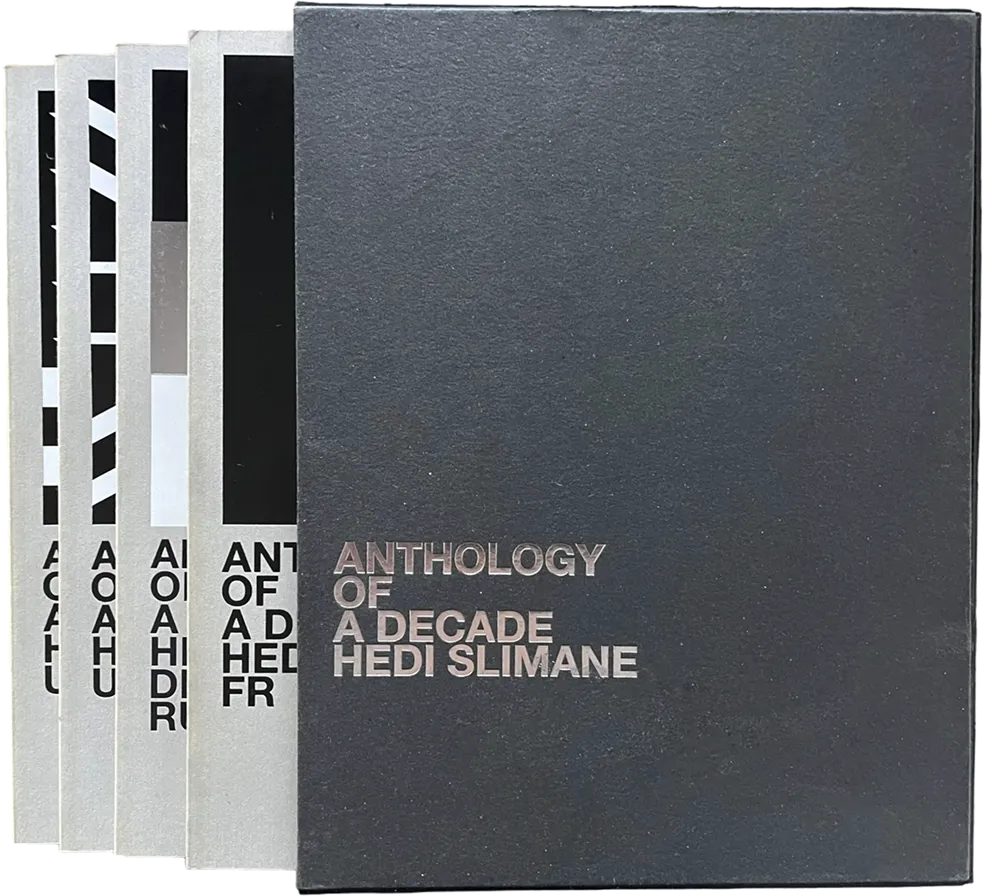
4 soft covers in slipcase
ISBN:
9783037641156


Hedi Slimane’s Anthology of a Decade serves as a monumental, two-volume definitive survey of the photographer’s defining visual output across the 2000s. Spanning extensive documentation of the international indie rock revival, LA underground art scenes, fashion design milestones, and raw youth culture, the publication compiles the breadth of Slimane’s stylistic evolution into a single overarching oeuvre.
The visual framework relies on his signature high-contrast black-and-white and muted color palettes, establishing a stark, cinematic continuity between backstage portraiture, desolate architecture, and transient street scenes. Rather than reading merely as a retrospective, the monograph functions as an immersive, cohesive document of a cultural epoch defined by razor-thin silhouettes, nocturnal excess, and raw aesthetic autonomy.