
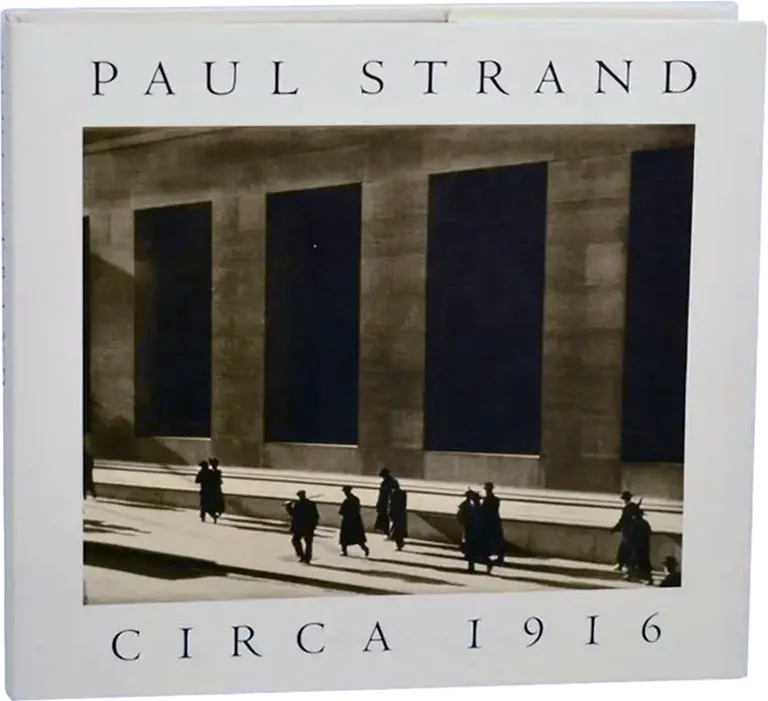
Hardcover with dust jacket
ISBN:


Paul Strand’s output around 1916 marks a radical watershed moment not only in his own career but in the entire trajectory of American modernism. Mentored by Alfred Stieglitz and breaking decisively from the romantic, soft-focus conventions of Pictorialism, Strand began producing images that aggressively confronted the raw reality of the modern city. This body of work represents the birth of "straight photography", a practice demanding sharp focus, deep depth of field, and an unvarnished look at contemporary life. By turning his lens on the harsh geometry of Wall Street, brutal street portraits, and the stark abstraction of everyday objects like bowls and porch railings, Strand established a new photographic vocabulary grounded in objective truth rather than painterly imitation.
Aesthetically, these photographs rely on strict structural compositions and high contrasts. Strand utilized radical cropping to flatten space and emphasize the graphic qualities of his subjects, stripping away unnecessary context to isolate pure form. His street portraits, famously captured with a false-lens camera to catch subjects unawares, possess an uncompromising physical presence. The resulting images balance heavy, rich blacks with brilliant highlights, treating the human face, architectural monoliths, and mundane domestic objects with the same exacting geometric rigor.
Within the history of the medium, the images created during this exact period, many of which were famously published in the final issues of Camera Work, are foundational texts of modern art. For the Bushwick sur Seine archive, this body of work is an essential cornerstone. Strand’s pioneering approach to formalist abstraction and his insistence on the photograph as an autonomous, mechanically reproduced object directly inform the collection's core philosophy. Preserving this defining era highlights the moment strict structural observation became the primary engine of photographic modernism.