
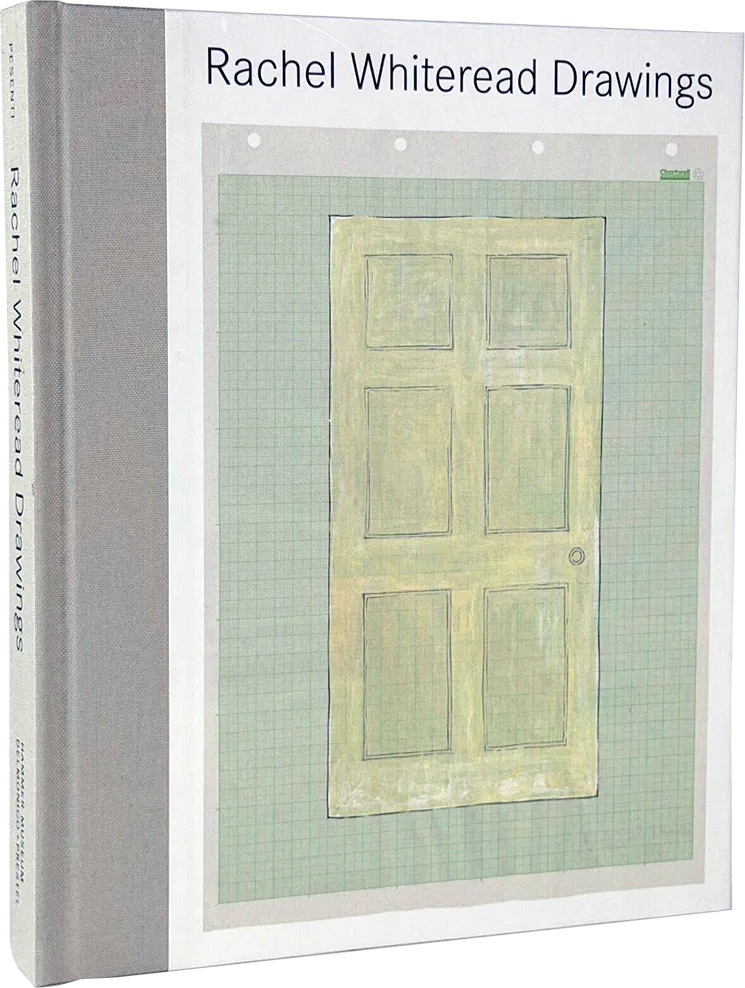
Hardcover without dust jacket, as issued
ISBN:
9783791350387


Rachel Whiteread’s Drawings provides a crucial, intimate counterpoint to the monumental sculptural casts of negative space that have largely defined her career. Published in conjunction with her first major museum retrospective dedicated exclusively to works on paper, this volume reveals the underlying conceptual architecture of her practice. Rather than serving as mere preparatory sketches or blueprints, Whiteread’s drawings function as independent meditations on memory, domesticity, and absence. They document her process of thinking through volume and void, translating the heavy, physical mass of displaced architectural space into a delicate, two-dimensional vernacular.
Aesthetically, the work relies on a highly specific material vocabulary that echoes the industrial textures of her physical sculptures. Whiteread frequently employs correction fluid (Tipp-Ex), opaque white acrylic, resin-like varnish, and watercolor on graph paper to build dense, layered surfaces. These materials create a palpable spatial tension on the page, where the rigid, mechanical grid of the graph paper imposes a strict geometric order against the fluid, ghostly pooling of white pigment. The resulting compositions isolate floor plans, door frames, and floorboards into stark formalist abstractions, successfully capturing the luminous, translucent qualities of her cast resin and plaster works within a flattened visual field.