
SOLD
Copyright ©
Bill Owens
or applicable right holders.


Bill Owens, Suburbia, 1973

Bill Owens, Suburbia, 1973
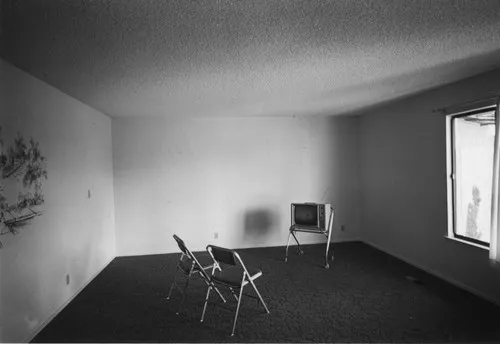
This photograph by Bill Owens, commonly titled Empty room with 2 chairs (1971), is a defining image from his landmark photobook Suburbia (1972).
In the late 1960s and early 1970s, Owens worked as a photojournalist for the Livermore Independent newspaper in Northern California. Surrounded by rapid housing developments, he documented the post-WWII migration from inner cities to the affordable, mass-produced tract housing of the East Bay Area. His goal was to approach the customs, rituals, and material achievements of middle-class Americans with an anthropologist’s eye.
The image encapsulates the stark, minimalist beginning of the suburban dream. Many families stretched their finances to afford these newly built tract homes, arriving with very little furniture. The empty room with just two folding chairs and a television symbolizes a blank canvas, a space full of aspirational potential, yet caught in a state of temporary "making do".
In post-war suburbia, the television was the ultimate portal to the outside world and the new anchor of the American living room. Even when a house lacked proper furniture, the TV was often the very first appliance installed, serving as both entertainment and a symbol of modern domestic success.
Most photographs in Suburbia are accompanied by candid, sometimes humorous quotes from the homeowners explaining their lifestyles. This specific photograph is one of the few uncaptioned images in the book. By leaving it silent, Owens allows the bare room to speak universally about the isolation, simplicity, and stark realities of mid-century consumer culture.
Bill Owens, Suburbia, 1973



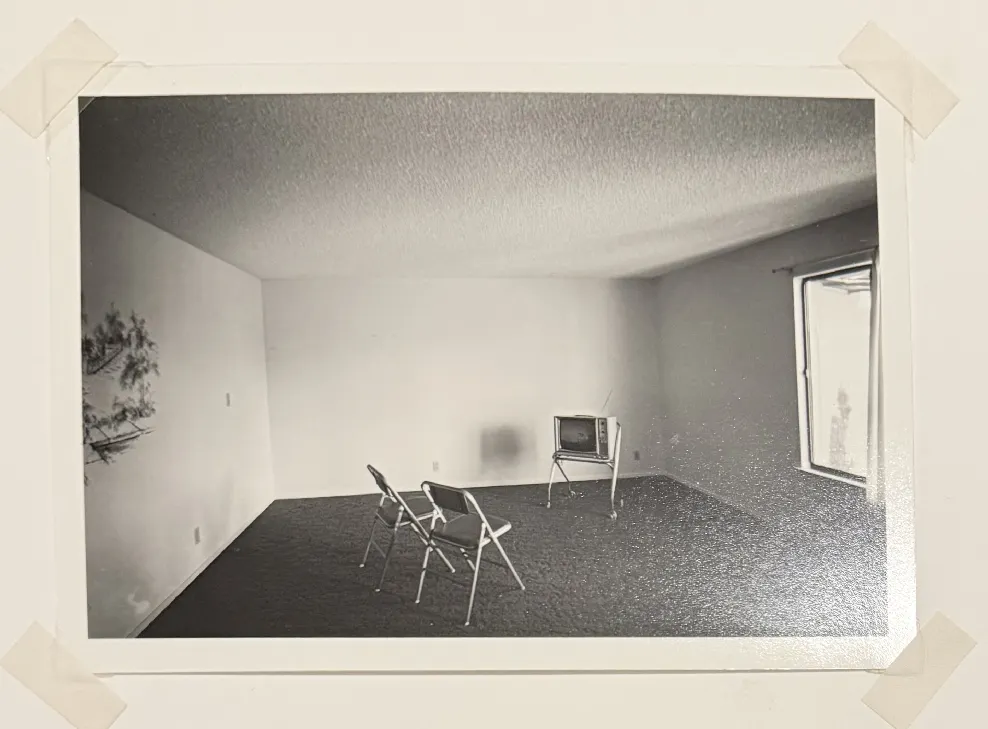
This photograph by Bill Owens, commonly titled Empty room with 2 chairs (1971), is a defining image from his landmark photobook Suburbia (1972).
In the late 1960s and early 1970s, Owens worked as a photojournalist for the Livermore Independent newspaper in Northern California. Surrounded by rapid housing developments, he documented the post-WWII migration from inner cities to the affordable, mass-produced tract housing of the East Bay Area. His goal was to approach the customs, rituals, and material achievements of middle-class Americans with an anthropologist’s eye.
The image encapsulates the stark, minimalist beginning of the suburban dream. Many families stretched their finances to afford these newly built tract homes, arriving with very little furniture. The empty room with just two folding chairs and a television symbolizes a blank canvas, a space full of aspirational potential, yet caught in a state of temporary "making do".
In post-war suburbia, the television was the ultimate portal to the outside world and the new anchor of the American living room. Even when a house lacked proper furniture, the TV was often the very first appliance installed, serving as both entertainment and a symbol of modern domestic success.
Most photographs in Suburbia are accompanied by candid, sometimes humorous quotes from the homeowners explaining their lifestyles. This specific photograph is one of the few uncaptioned images in the book. By leaving it silent, Owens allows the bare room to speak universally about the isolation, simplicity, and stark realities of mid-century consumer culture.