SOLD
Copyright ©
Lewis Baltz
or applicable right holders.
Poster


The New Industrial Parkways, Castelli Graphics, 1974 Plate 27 and back cover; The Steidl 2001 reprint, as well as the Steidl reprint set, 2005, Plate 27; Mirrors and Windows: American Photography since 1960, John Szarkowski, MOMA, 1978, p. 84.


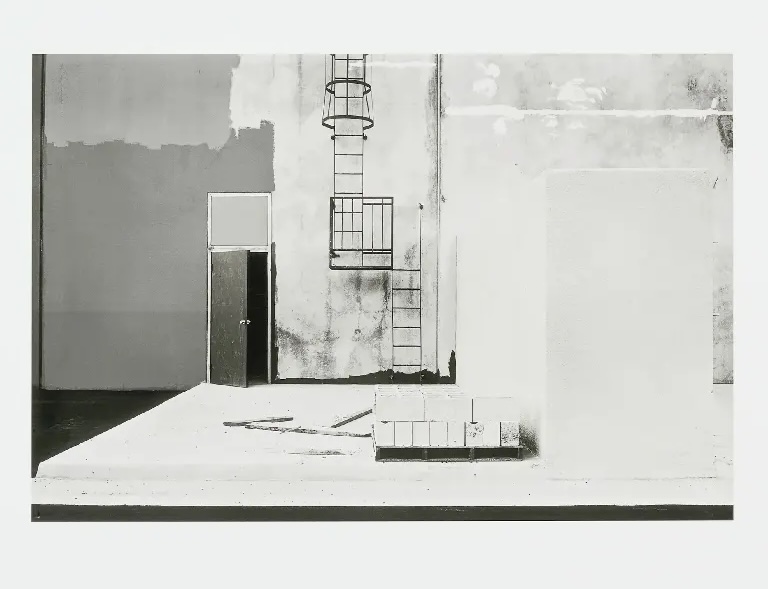
Element No. 27 (from 'New Industrial Parkways') exemplifies the photographer’s clinical, detached exploration of corporate architectural typologies during the early 1970s. Part of his seminal series documenting the master-planned industrial parks of Orange County, California, this image focuses on the austere, standardized surfaces of modern commercial infrastructure.
The composition relies on a flat-footed frontal perspective that strips away spatial depth, transforming architectural siding, concrete panels, and seams into a precise geometric grid. The neutral, ambient daylight eliminates dramatic shadows, reinforcing a sense of forensic objectivity and quiet alienation. Baltz sidesteps romanticism entirely, presenting the built environment as a silent, monolithic artifact of late-capitalist development.
Within Baltz’s broader oeuvre, Element No. 27 stands as a defining work of the New Topographics movement, redefining landscape photography through man-made industrial spaces.
This print was released in 2005 as part of the limited edition of the 3-volume set re-issue of The New Industrial Parkways, The Prototype Works and The Tract Houses.
The New Industrial Parkways, Castelli Graphics, 1974 Plate 27 and back cover; The Steidl 2001 reprint, as well as the Steidl reprint set, 2005, Plate 27; Mirrors and Windows: American Photography since 1960, John Szarkowski, MOMA, 1978, p. 84.