

SOLD
Copyright ©
Sigmar Polke
or applicable right holders.


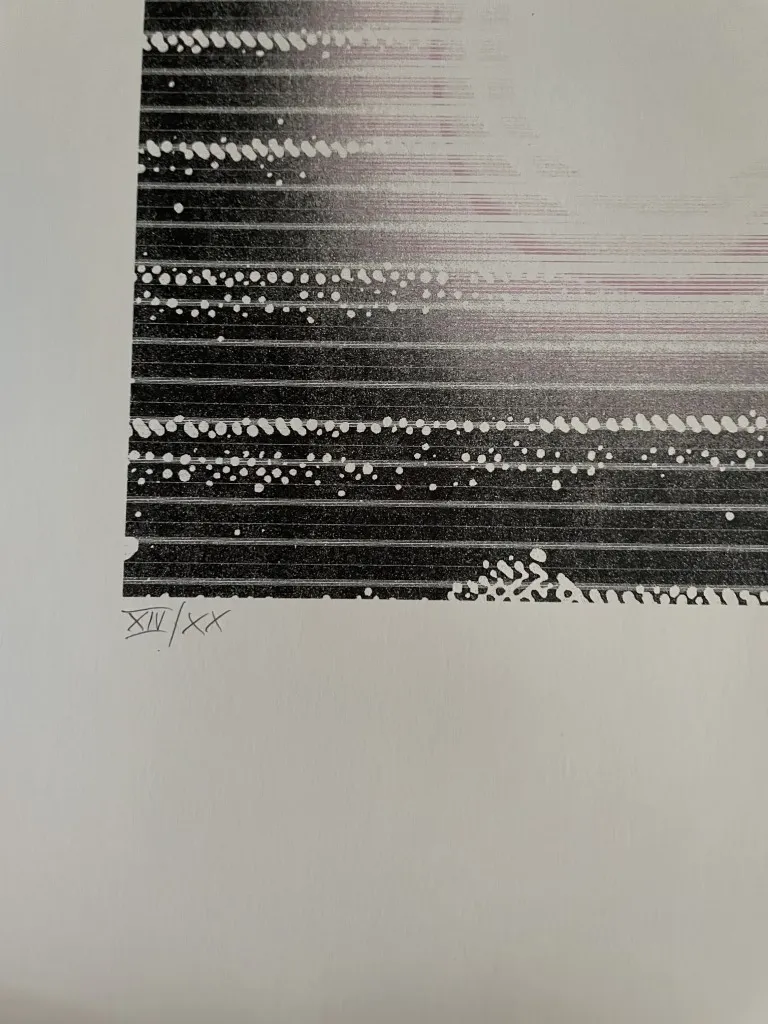
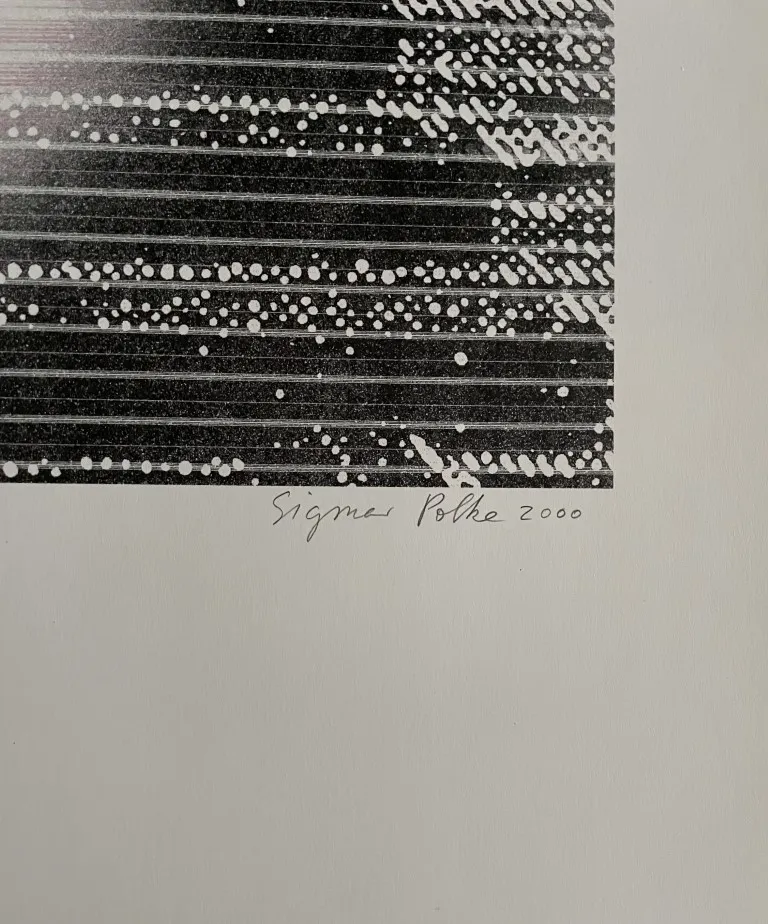
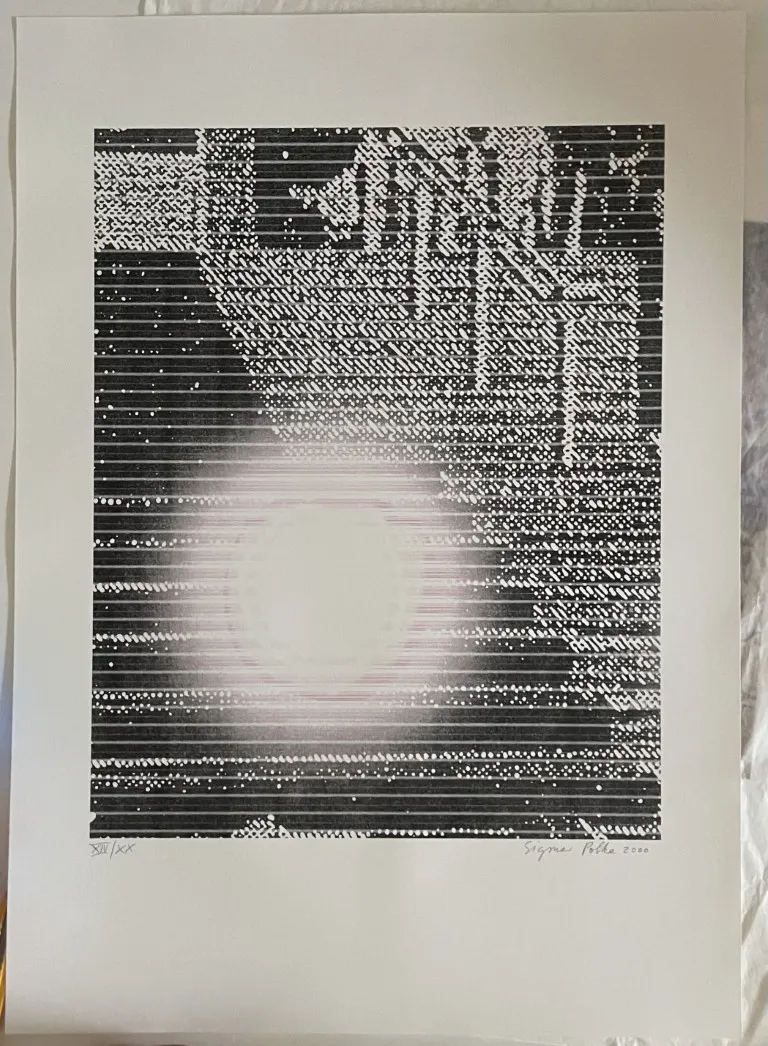
Die Treppe von Cannes (2000) is a notable graphic edition by Sigmar Polke that exemplifies his satirical critique of media spectacle and celebrity culture. Translating to "The Stairs of Cannes," the work directly references the iconic red-carpeted steps of the Palais des Festivals at the Cannes Film Festival. Fascination with mass culture and consumer obsession led Polke to focus on Cannes as a symbol of prestige, glamour, and visual illusion. The artwork was conceived and created directly as a printed graphic edition rather than being painted on canvas first. Published as an offset lithograph on cardboard in an edition of 75 with 20 artist proofs, the heavy support gives a physical permanence to an otherwise fleeting media image. Polke treated prints and editions as a primary, standalone medium rather than secondary reproductions of gallery paintings. Rather than capturing a clean photo, he manipulated found press imagery by overlaying halftone raster dots and visual noise to question the truthfulness of mass-produced media. The work was published by Edition Staeck in Heidelberg, founded by Klaus Staeck, a frequent collaborator who shared Polke's vision of democratic printmaking. Though produced in 2000, the print carries the core conceptual spirit of the Capitalist Realism movement Polke co-founded in the 1960s.
Today, this piece is preserved within the Bushwick Sur Seine collection, representing Polke's lifelong engagement with mechanical reproduction, image distortion, and tactile materiality.



Die Treppe von Cannes (2000) is a notable graphic edition by Sigmar Polke that exemplifies his satirical critique of media spectacle and celebrity culture. Translating to "The Stairs of Cannes," the work directly references the iconic red-carpeted steps of the Palais des Festivals at the Cannes Film Festival. Fascination with mass culture and consumer obsession led Polke to focus on Cannes as a symbol of prestige, glamour, and visual illusion. The artwork was conceived and created directly as a printed graphic edition rather than being painted on canvas first. Published as an offset lithograph on cardboard in an edition of 75 with 20 artist proofs, the heavy support gives a physical permanence to an otherwise fleeting media image. Polke treated prints and editions as a primary, standalone medium rather than secondary reproductions of gallery paintings. Rather than capturing a clean photo, he manipulated found press imagery by overlaying halftone raster dots and visual noise to question the truthfulness of mass-produced media. The work was published by Edition Staeck in Heidelberg, founded by Klaus Staeck, a frequent collaborator who shared Polke's vision of democratic printmaking. Though produced in 2000, the print carries the core conceptual spirit of the Capitalist Realism movement Polke co-founded in the 1960s.
Today, this piece is preserved within the Bushwick Sur Seine collection, representing Polke's lifelong engagement with mechanical reproduction, image distortion, and tactile materiality.