SOLD
Copyright ©
Willy Ronis
or applicable right holders.
Poster



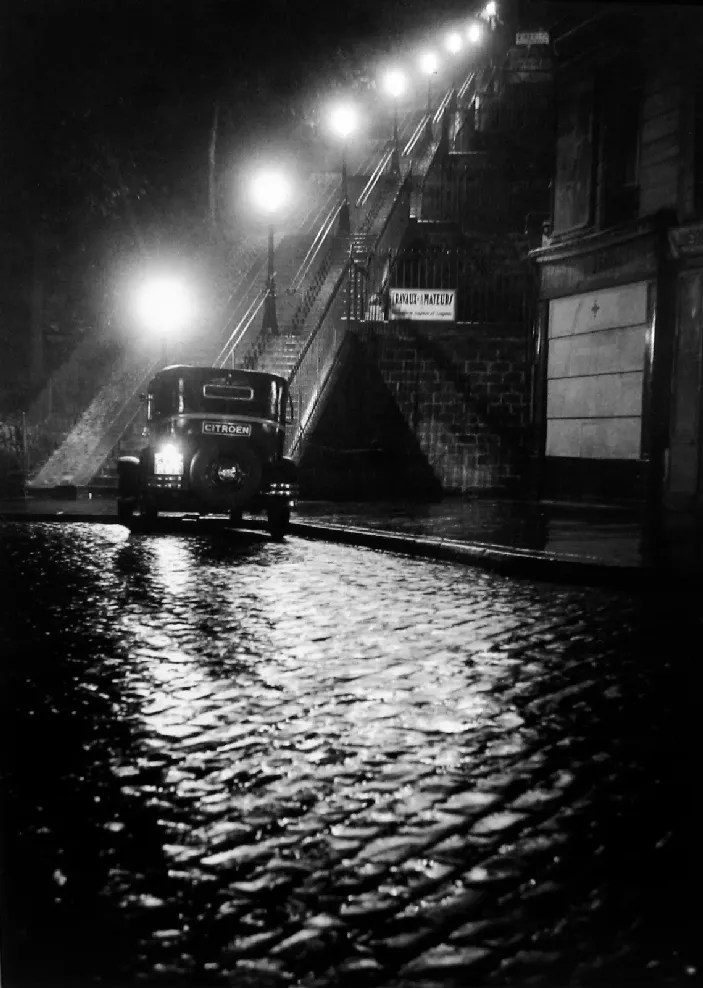
Willy Ronis’s Rue Muller captures a pivotal juncture in the development of interwar French photography, standing as a direct successor to the atmospheric nocturnal urbanism pioneered by Brassaï. Taken in 1934 just shortly after the late 1932 release of Paris de Nuit, the image reflects a shared fascination with the geometry, texture, and quiet theatricality of the Parisian street after dark, yet pivots toward the humanist empathy that would define Ronis’s lifelong trajectory. Rather than plunging entirely into the subterranean shadows of the capital's nocturnal underworld, Ronis frames the urban landscape with a structural clarity and social warmth that honors the physical environment while remaining intimately connected to human scale.
Visually, the composition relies on strong architectural framing, tonal contrast, and spatial recession, utilizing the steep incline and masonry of the Montmartre street to anchor the viewer's eye. The interplay between cast shadows and the soft illumination of streetlamps highlights Ronis's mastery of gelatin silver printing, emphasizing the physical grain and tactile quality of the urban fabric. This formal rigor transforms a simple neighborhood byway into a carefully balanced stage set, where the built environment feels both monumental and intensely lived-in.
Within the broader scope of the artist's oeuvre, Rue Muller marks an essential early exploration into the poetry of ordinary Parisian life, laying the groundwork for the serial observation and street-level sensitivity that would anchor Ronis's contributions to French humanist photography.