Andreas Gursky

Andreas Gursky

Which art books, prints and posters are available by and about this artist? Here is a sample of items of interest to a typical collector:

→
Te Neues
2000
with:
Edition:
1st US (1998 Schirmer)
Edition size:
Out of Print
→
Cantz
1998
with:
Edition:
1st
Edition size:
Out of Print
→

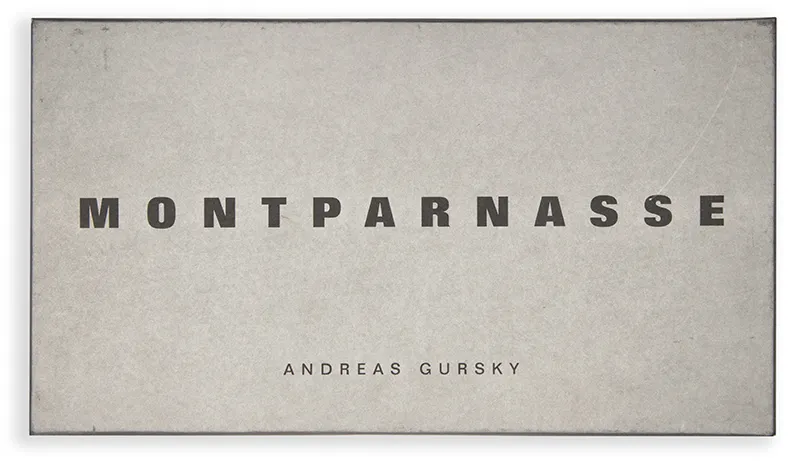
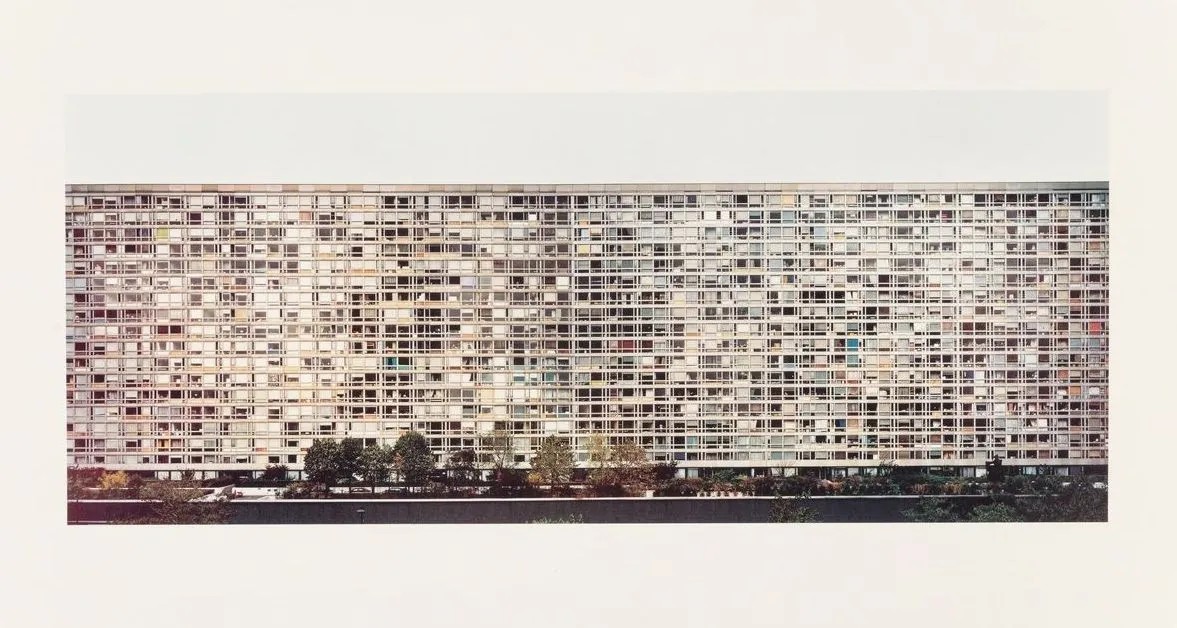
Andreas Gursky’s Montparnasse operates as a defining document of late-capitalist globalization, centering on his monumental depiction of the Immeuble Maine-Montparnasse housing estate in Paris. As a publication, it encapsulates a pivotal transition in his career, marking his definitive shift away from single-exposure documentary observation toward meticulously engineered, digitally stitched tableaux. By taking an architectural monolith designed to house thousands and reducing it to a serialized study of mass society, the project reflects Gursky’s broader investigation into the overwhelming scale of modern urban living and the anonymity of the human condition within engineered environments.

Aesthetically, the work is characterized by its unrelenting, grid-like composition and an all-over, edge-to-edge sharpness that denies the viewer a central point of focus. By digitally combining multiple large-format negatives, Gursky eliminated natural spatial distortion, resulting in a flat, coldly objective framework. Translated into the pages of a photobook, this massive architectural facade transforms into a highly concentrated, almost microscopic matrix of color and geometry. The domestic details and anonymous residents trapped within the grid demand close, rigorous inspection, forcing an intimate reading of a subject that is inherently vast and alienating.

This 1995 publication was conceived exclusively as this specific three-part portfolio, co-published by Portikus and Oktagon Verlag to accompany an exhibition at Portikus in Frankfurt. It remains to-date the only publication ever released regarding this project. It was issued in an unnumbered edition, housed entirely in the signature silver cardboard clamshell box.  

The portfolio itself is structured into three distinct elements rather than a traditional bound book:

  • The publication is split into two softcover volumes, one dedicated purely to text ("Texte") and the other to visuals ("Image")
  • The offset lithograph is contained within a dedicated folder that is inscribed with the names of the more than 750 resident families who lived in the Immeuble Maine-Montparnasse. This specific detail is a critical conceptual element of the edition, directly addressing Gursky's themes of mass society by naming the anonymous figures swallowed up by the building's massive architectural grid.  

Because the project was designed as a sculptural object that deconstructs the traditional photobook format into separate textual, visual, and tactile components, it was never mass-produced as a conventional single-volume trade hardcover or paperback.

Portikus & Oktagon Verlag
1995
with:
Edition:
1st
Edition size:
Out of Print
1995

Portikus & Oktagon Verlag

Out of Print
Signed
Edition:
1st
Prior edition(s):
Two softcovers with print in a silver clamshell
Conditon:
Light wear to box. Print and booklets in pristine condition.
→
Mack Books
2023
with:
Edition:
1st
Edition size:
Out of Print
→
Cantz
2011
with:
Edition:
3rd reprint (2008)
Edition size:
Out of Print
→
Gagosian
2010
with:
Edition:
1st
Edition size:
Out of Print
→
Steidl
2012
with:
Edition:
1st
Edition size:
Out of Print
→
Cantz
2008
with:
Edition:
1st
Edition size:
Out of Print
→
Gagosian & Rizzoli
2015
with:
Edition:
1st
Edition size:
Out of Print
→
MOMA
2001
with:
Edition:
2nd prt (2001)
Edition size:
Out of Print
→
Cantz
2007
with:
Edition:
1st
Edition size:
Out of Print
→
Polígrafa
2000
with:
Gunther Forg, Candida Hoefer, Thomas Ruff, Hiroshi Sugimoto, Jeff Wall
Edition:
1st
Edition size:
Out of Print
→
Walther König
2021
with:
Edition:
1st
Edition size:
Out of Print
→
Cantz & Louisiana Museum
2012
with:
Edition:
1st
Edition size:
Out of Print
→

There are different ISBNs for each book

Snoeck
2008
with:
Edition:
1st
Edition size:
Out of Print
No items found.

Andreas Gursky, German, b. 1955, is an influential contemporary photographers, renowned for his monumental, digitally manipulated images that capture the overwhelming scale of globalization and late-capitalist society. Emerging from the Kunstakademie Düsseldorf under the tutelage of Bernd and Hilla Becher in the 1980s, Gursky initially adopted their method of detached, objective observation. However, by the early 1990s, he broke away from strict documentary practices by utilizing digital editing to stitch together multiple large-format negatives. This technological shift allowed him to create impossible, edge-to-edge sharp perspectives from elevated vantage points, stripping away natural spatial distortion to transform chaotic reality into mathematically precise, hyper-detailed panoramas.

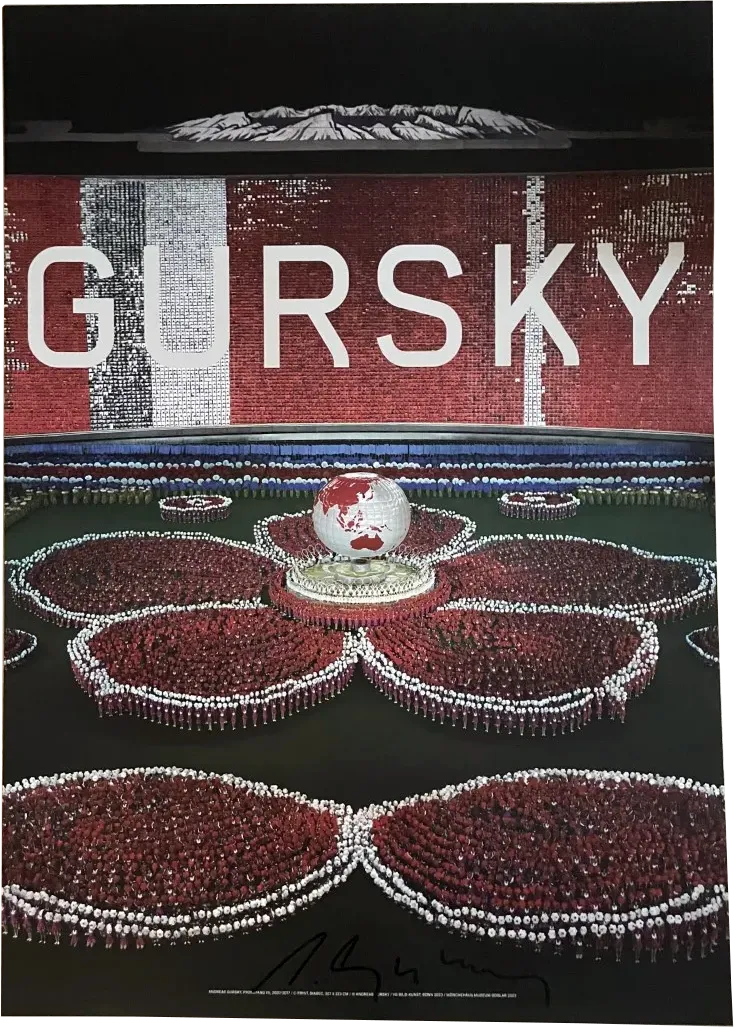
Throughout his career, his output has been defined by a continuous investigation into massive, anonymous, man-made spaces and the sheer density of modern human activity. His 1990s work frequently focused on global commerce, trading floors, and modern architecture, exemplified by images like Paris, Montparnasse and Rhein II, which pushed physical environments into striking, almost painterly geometric abstractions. In the 2000s, his scope expanded to include overwhelming consumer environments, famously captured in the brightly colored, endlessly repeating aisles of 99 Cent, as well as highly choreographed mass human spectacles like the Arirang Festival in his Pyongyang series. More recently, his practice has evolved to incorporate high-definition satellite imagery, constructing sprawling, macroscopic views of the Earth's surface in his Ocean series. Across all these periods, Gursky continually redefines the boundaries between photographic truth and digital invention, utilizing the massive physical scale of his prints to compete with the presence of traditional history painting.