
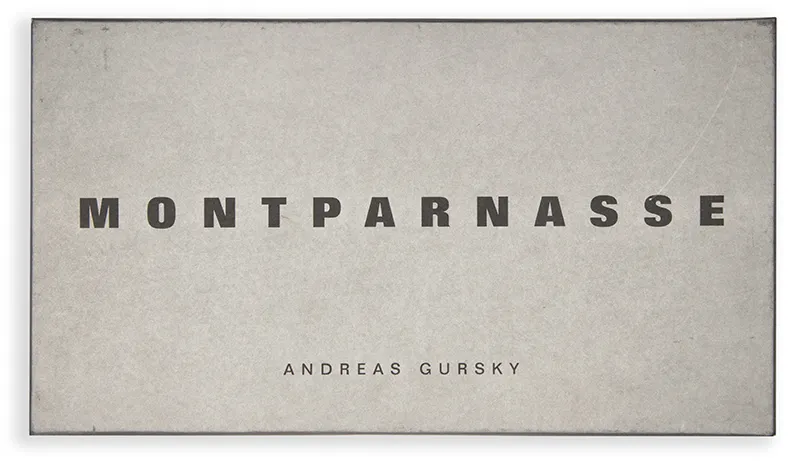
Two softcovers with print in a silver clamshell
ISBN:
9783896110039


Andreas Gursky’s Montparnasse operates as a defining document of late-capitalist globalization, centering on his monumental depiction of the Immeuble Maine-Montparnasse housing estate in Paris. As a publication, it encapsulates a pivotal transition in his career, marking his definitive shift away from single-exposure documentary observation toward meticulously engineered, digitally stitched tableaux. By taking an architectural monolith designed to house thousands and reducing it to a serialized study of mass society, the project reflects Gursky’s broader investigation into the overwhelming scale of modern urban living and the anonymity of the human condition within engineered environments.
Aesthetically, the work is characterized by its unrelenting, grid-like composition and an all-over, edge-to-edge sharpness that denies the viewer a central point of focus. By digitally combining multiple large-format negatives, Gursky eliminated natural spatial distortion, resulting in a flat, coldly objective framework. Translated into the pages of a photobook, this massive architectural facade transforms into a highly concentrated, almost microscopic matrix of color and geometry. The domestic details and anonymous residents trapped within the grid demand close, rigorous inspection, forcing an intimate reading of a subject that is inherently vast and alienating.
This 1995 publication was conceived exclusively as this specific three-part portfolio, co-published by Portikus and Oktagon Verlag to accompany an exhibition at Portikus in Frankfurt. It remains to-date the only publication ever released regarding this project. It was issued in an unnumbered edition, housed entirely in the signature silver cardboard clamshell box.
The portfolio itself is structured into three distinct elements rather than a traditional bound book:
Because the project was designed as a sculptural object that deconstructs the traditional photobook format into separate textual, visual, and tactile components, it was never mass-produced as a conventional single-volume trade hardcover or paperback.