

Which art books, prints and posters are available by and about this artist? Here is a sample of items of interest to a typical collector:


Bettina Grossman (1927–2021) was an American conceptual artist whose prolific, multidisciplinary oeuvre spanned drawings, sculptures, early computer-generated films, and systematic photographic documentation. Born in Brooklyn and raised within an Orthodox Jewish family, she studied commercial art and worked as a textile designer before spending several years in Europe during the 1950s and 1960s to immerse herself in avant-garde art.
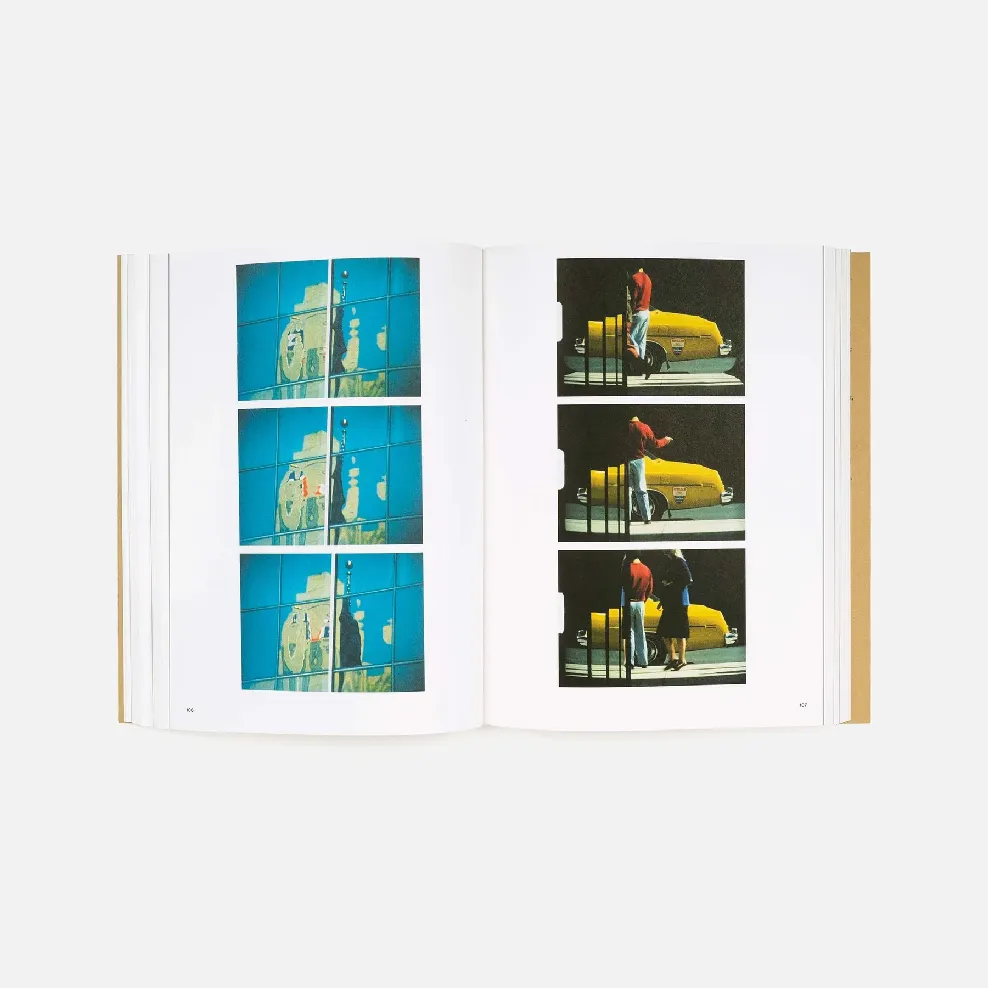
Following a devastating studio fire in the late 1960s that destroyed much of her early output, Bettina shifted her artistic philosophy toward modular, systemic practices that rejected the notion of the isolated art object. In the early 1970s, she settled into room 503 of Manhattan's historic Hotel Chelsea, which served as both her living quarters and an intensely packed studio for nearly five decades. Her rigorous investigations into urban phenomenology are perhaps best exemplified by The Fifth Point of the Compass, a massive undertaking from 1977 to 1985 in which she shot over 8,000 color slides from her fifth-floor balcony, systematically cataloging the rhythmic, ephemeral movements of pedestrians and traffic on 23rd Street.
Infused with influences from mathematics, physics, and mysticism, her work treats pattern, grids, and text as interconnected elements of a vast, ongoing conceptual matrix. Although she spent decades living in near-isolation surrounded by her archives at times sleeping in a hallway lawn chair due to the spatial overflow of her work, she experienced a profound late-career renaissance. Her art gained renewed institutional acclaim through major presentations, including collaborations on Governors Island, a retrospective focus at MoMA PS1's Greater New York exhibition, and dedicated archival preservation efforts ensuring her visionary contributions to conceptual art are permanently recognized.


Based off an archaeological recovery project, Bettina serves as the first comprehensive monograph of the visionary conceptual artist Bettina Grossman. Living a reclusive life in New York’s Chelsea Hotel from 1968 until her death in 2021, Bettina transformed her apartment into a dense, overflowing archive of her own prolific output. Edited by artist Yto Barrada and designer Gregor Huber, the publication systematically catalogs an unseen, wildly interdisciplinary practice that bridged photography, sculpture, textile, and cinema. Rather than a standard retrospective, the book functions as a collaborative translation of her physical space, bringing light to an unsung artist who obsessively dedicated her life to the abstraction of the everyday.
Aesthetically, Bettina’s visual language is defined by a strict adherence to geometric abstraction, seriality, and pattern. Frequently photographing pedestrians, shadows, and architectural fragments from her high-rise window, she isolated the chaotic movement of the street into rigorous graphic typologies. Her methodology treated the camera not as a straightforward documentary tool, but as a generative starting point. The photographs were continuously manipulated and reimagined, eventually morphing into sculptural pieces and abstract “verbal forms”. The publication itself mirrors this obsessive seriality, utilizing a dense, structured sequencing that highlights how she seamlessly dissolved the boundaries between two-dimensional capture and three-dimensional form.