


Copyright ©
Jungjin Lee
or applicable right holders.


Which art books, prints and posters are available by and about this artist? Here is a sample of items of interest to a typical collector:


Jungjin Lee, South Korean, b. 1961
Lee is internationally revered for breathtaking black-and-white photographs that evoke a deep, meditative state. In her practice, Lee has concentrated on capturing vast, expansive landscapes from around the globe, from deserts to oceans to mountains. She is interested in eternity and exploring how the landscape might reflect inner emotional states. Working with large-format cameras and printing on handmade mulberry paper, Lee is also known for her technical craftsmanship.
Lee began photographing in the 1980s while studying ceramics at Hongik University. In the early 1990s various trips took her into the endless expanse of America, where she captured archaic, primal images of deserts, rocks, undergrowth, and cactuses. Drawing on her South Korean heritage, the artist developed a highly unique pictorial language in series such as Ocean, On Road, Pagodas, Things, and Wind, in which her fundamental interest in nature and culture is expressed in a space of poetic resonance. In her work, Jungjin Lee taps her profound understanding for materiality, texture, and craftsmanship. Working with Liquid Light, she applies photosensitive emulsion onto rice paper with a coarse brush.
In 1991 she graduated from New York University with an MFA in photography. She soon after worked as an assistant to acclaimed photographer Robert Frank. By 1996 her work was regularly exhibited at major institutions, including the Musée d’Art Moderne de la Ville de Paris, the Whitney Museum of American Art, and the Los Angeles County Museum of Art. In 2021, Lee participated in the Bienal de São Paulo.


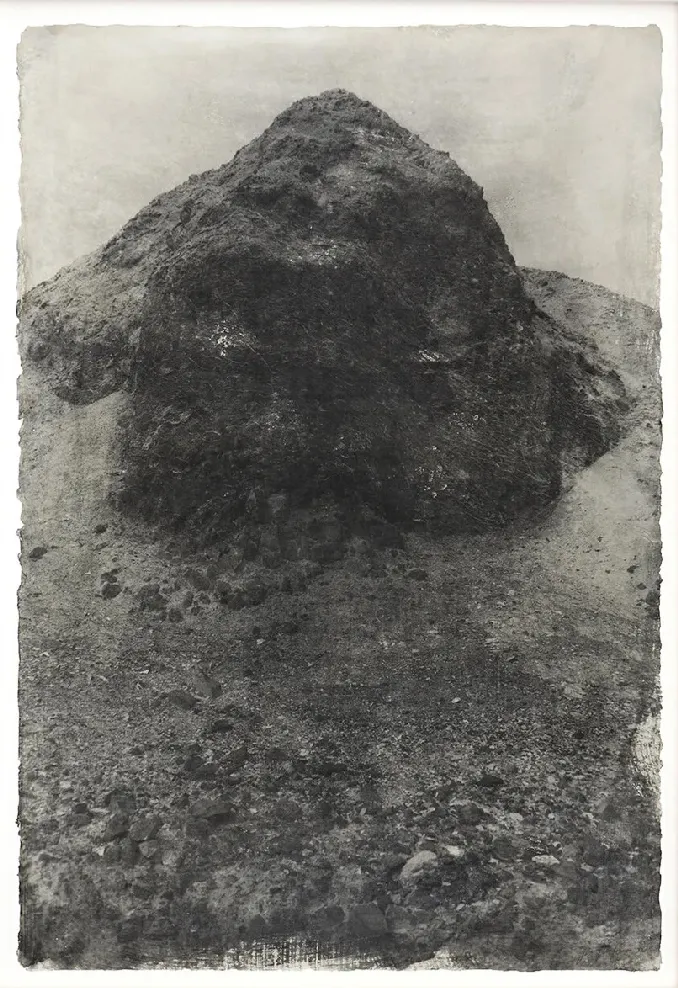
Desert stands as an essential formalist investigation into vast, primordial topographies, deepening Lee's ongoing exploration of landscape as a reflective mirror for interior emotional states. Following landmark series such as Ocean and Wind, this project applies her singular visual vocabulary to the arid expanses of the American Southwest. Positioned within Lee’s broader oeuvre, the series highlights her foundational training in ceramics and photography, bridging traditional East Asian painterly sensibilities with a rigorous West Coast photographic formalism to transform desolate geographical terrain into a meditative, timeless space.
Aesthetically, the work is defined by stark tonal contrast, tactile materiality, and subtle spatial tension. Lee isolates rugged rock formations, sweeping desert floors, and barren brush, stripping away decorative detail to focus on elemental structure and raw form. Her signature process, brushing Liquid Light photosensitive emulsion directly onto handmade Korean mulberry paper, imparts a coarse, painterly texture that softens sharp physical features into quiet abstractions. The deliberate interplay between dense physical matter and sweeping negative space creates an atmospheric stillness, framing the desert not merely as a barren environment, but as a monumental venue for stillness and introspective resonance.