
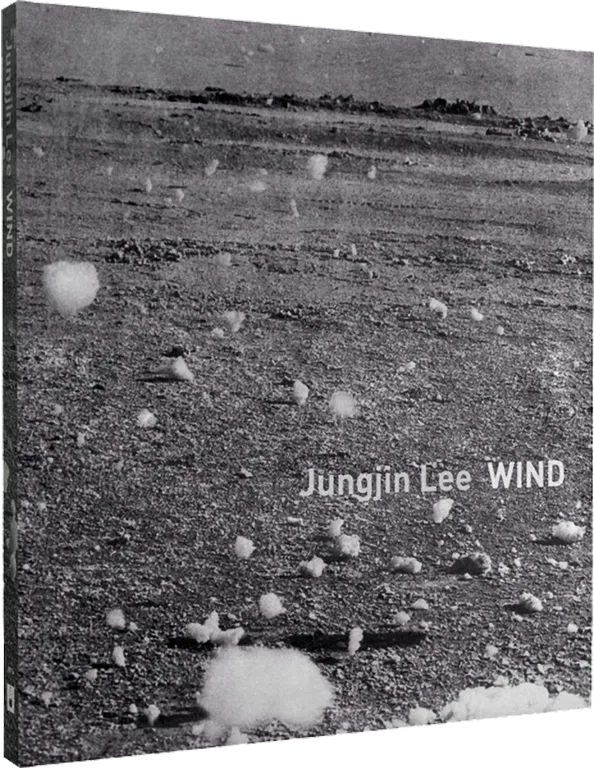
Hardcover with dust jacket
ISBN:
9781597111287


Wind represents a pivotal milestone in Lee's mid-career trajectory, capturing the unseen, ephemeral force of wind through its physical impact on the American landscape. Building upon her foundational studies in ceramics and her tenure as an assistant to Robert Frank, Lee uses this series to bridge East Asian minimalist philosophies with Western photographic formalism, transforming vast, desolate topographies into introspective, poetic visual spaces.
Aesthetically, the work is defined by an extraordinary tactile presence, stark tonal contrast, and rigorous spatial tension. Lee captures isolated trees, sweeping plains, and wind-swept brush, framing them not as mere geographical landscapes, but as elemental symbols of endurance and passage. Her signature technique, brushing Liquid Light photosensitive emulsion directly onto handmade Korean mulberry paper, imparts a textured, painterly dimensionality to each image. The resulting compositions balance heavy physical materiality with a sense of atmospheric transience, where negative space functions as an active structural force.