
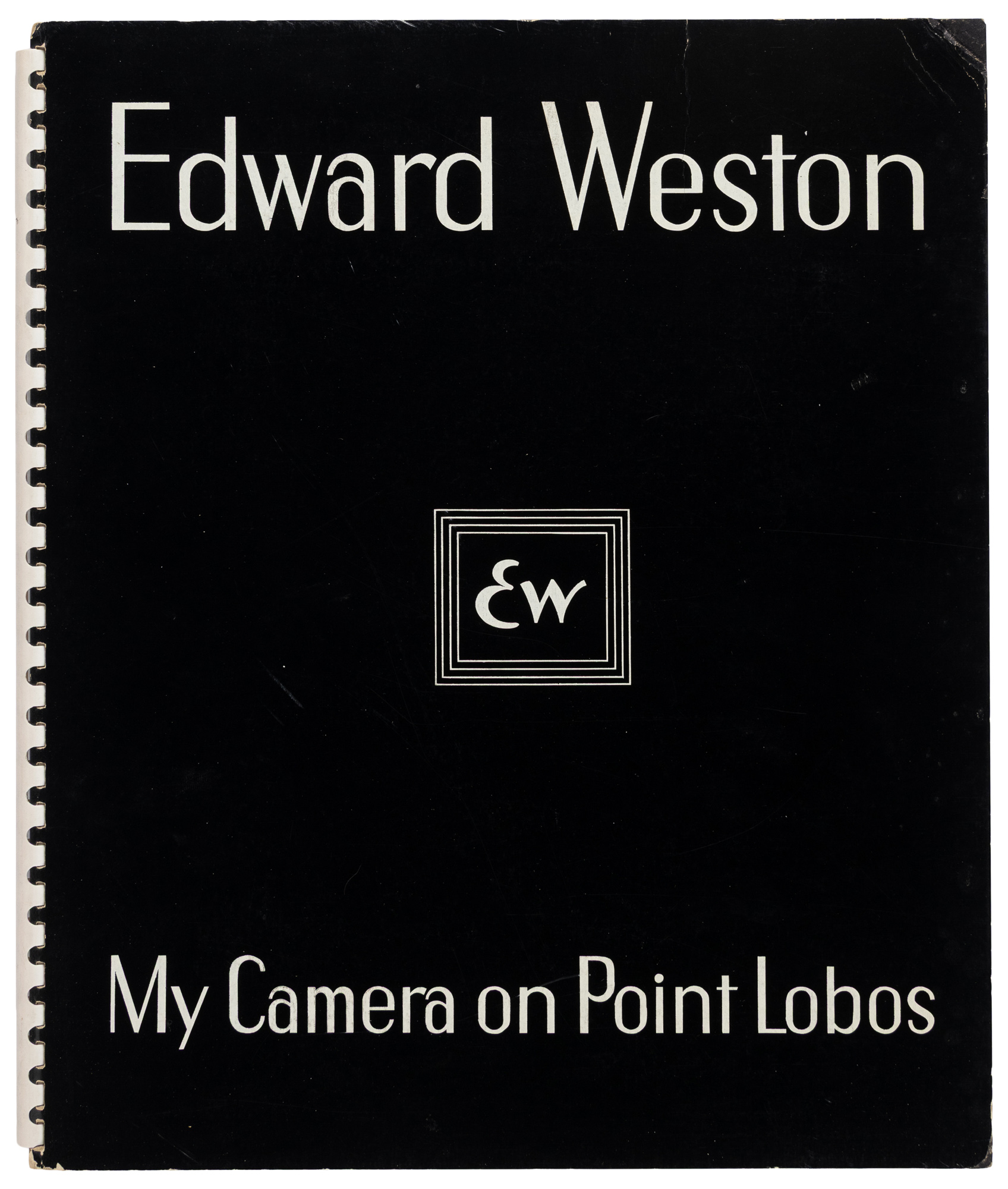


By the late 1920s Weston had left behind the soft-focus pictorialism of his early career and settled near Point Lobos, the rocky headland south of Carmel, California whose wind-bent cypress, kelp beds, and tide pools became the central subject of his last two decades of work. This volume gathers thirty duotone plates made there between 1929 and 1948, interleaved with excerpts from Weston's own daybooks, giving the book the feel of a first-person account of how he actually worked the place, plate by plate.
The book was the second in a short run of oversized, spiral-bound photographic folios produced by Virginia Adams (Ansel Adams's wife and publishing partner) with Houghton Mifflin, following Ansel Adams's own My Camera in Yosemite Valley (1949). The format, large duotone plates on glossy stock, minimal typography, spiral-bound so the pages would lie flat, was built to let the photographs carry the book with as little interference as possible.
The introduction is by Dody Weston (later Dody Weston Thompson), who was Weston's studio assistant in these years before marrying his son Brett. Ansel Adams closes the book with "A Note on the Photographs," praising Weston's ability to achieve extraordinary power through directness and an almost total absence of darkroom manipulation, the straight-photography ethic both men had championed since co-founding Group f/64 in 1932. By the time of publication Weston had already stopped photographing, so the book stands as one of the first retrospective statements on his Point Lobos work made while he was still alive to see it.

By the late 1920s Weston had left behind the soft-focus pictorialism of his early career and settled near Point Lobos, the rocky headland south of Carmel, California whose wind-bent cypress, kelp beds, and tide pools became the central subject of his last two decades of work. This volume gathers thirty duotone plates made there between 1929 and 1948, interleaved with excerpts from Weston's own daybooks, giving the book the feel of a first-person account of how he actually worked the place, plate by plate.
The book was the second in a short run of oversized, spiral-bound photographic folios produced by Virginia Adams (Ansel Adams's wife and publishing partner) with Houghton Mifflin, following Ansel Adams's own My Camera in Yosemite Valley (1949). The format, large duotone plates on glossy stock, minimal typography, spiral-bound so the pages would lie flat, was built to let the photographs carry the book with as little interference as possible.
The introduction is by Dody Weston (later Dody Weston Thompson), who was Weston's studio assistant in these years before marrying his son Brett. Ansel Adams closes the book with "A Note on the Photographs," praising Weston's ability to achieve extraordinary power through directness and an almost total absence of darkroom manipulation, the straight-photography ethic both men had championed since co-founding Group f/64 in 1932. By the time of publication Weston had already stopped photographing, so the book stands as one of the first retrospective statements on his Point Lobos work made while he was still alive to see it.